Showing posts with label Auditorium. Show all posts

Thursday, September 19, 2024

Catherine (Shin-Rou) Lin in Conversation with Christian Baldini

On September 28, I will have the pleasure of conducting Brahms' Violin Concerto with Catherine Lin as our soloist with the Camellia Symphony Orchestra in Sacramento. Also on the program are Daniel Godsil's "Cathedral Grove" and Shostakovich's Symphony No. 1. Below is an interview with Catherine. (click here for ticket information)

Christian Baldini: Catherine, welcome, and let's start by talking about Brahms. What do you like the most about this concerto? Why is it special? What should people listen for in this piece?

Catherine Lin: Brahms is definitely one of my favorite violin concertos. It has a lot of beautiful melodies and lines between the solo violin and the orchestra. Why is this piece special? I think the most interesting thing and unusual thing is Brahms gives the orchestra a very strong role and, not just for the soloist. I highly recommend everyone to listen to the sixteen notes from the orchestra part in the first movement and the beautiful melody in the beginning of the second movement. All the themes can also be heard in the orchestra parts too.

CB: Let's talk about your beginnings with music. Growing up in Taiwan, how did you first encounter the violin? Did you play other instruments as well?

CL: First time I saw the violin was when I was three. My brother was practicing on his violin. I saw it and I told my mom I also want to play this instrument and she said, “Ok, only if you decide to make the violin as your career, otherwise you should just play the piano since I’m a piano teacher.” I was very excited and said yes! I will practice every day. Now, I feel very lucky that I made the right choice.

As for other instruments, as I mentioned, my mom is a piano teacher, so she taught me theory, piano and musicianship (like rhythm and solfège). So I know how to play piano and when I was in middle school, I also learned percussion for a year and that was fun!

CB: Who are some of your favorite composers? And favorite violin concertos?

CL: Paganini, Beethoven, and of course, Brahms. I like many violin concertos, such as Tchaikovsky, Sibelius and Glazunov, but if I have to pick one it will still be the Brahms violin concerto.

CB: Have you played a lot of chamber music as well? Is the experience different from playing as a soloist with an orchestra?

CL: Yes, I’ve played a lot! Playing chamber music is very fun, but it’s different from playing with an orchestra. The size of a chamber group is much smaller. Whereas orchestras have strings, winds and percussions. So they have much larger scale. For chamber music, I think discussion is more important than playing; you need to spend time discussing how to create good music and find compatible partners with similar music ideas.

CB: What's a day like for you? How much do you practice? Do you have hobbies? Do you exercise?

CL: I have a pretty busy life doing my schoolwork at San Francisco Conservatory of Music. I usually practice at least 3 to 4 hours on weekdays and practice more on the weekends. I like drawing and working out when I’m free.

CB: What is your advice for your musicians who are starting out? How does one deal with frustrations? How does one stay positive?

CL: listen carefully and practice slowly are my suggestions. Usually when I feel frustrated, I would find something I like to do like talking to friends or do something I enjoy to do like painting or playing with my cats.

CB: Thank you for your time Catherine, I look forward to making music with you!

CL: Thank you, Maestro for inviting me to play with you and this amazing orchestra!


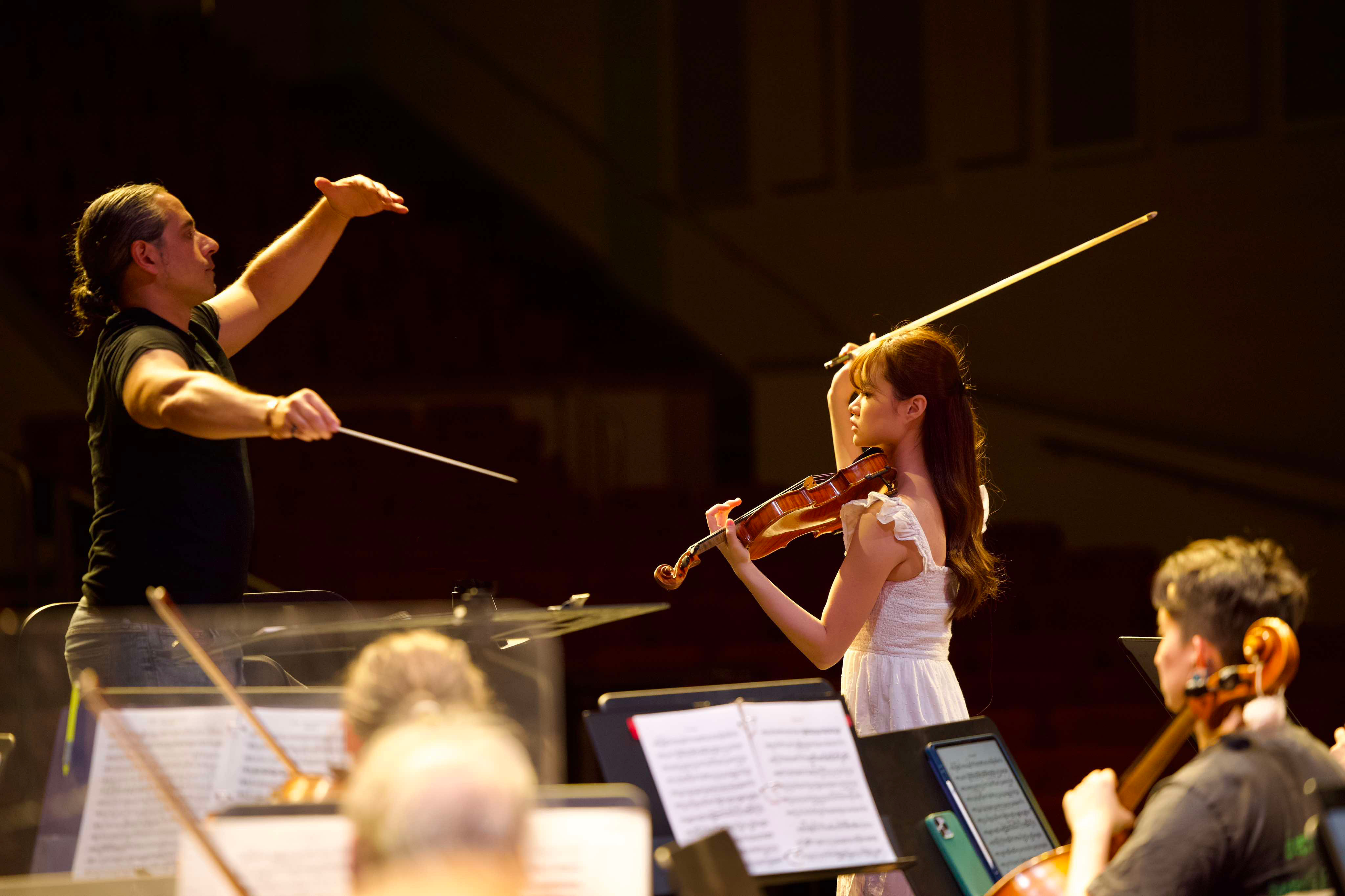
Catherine Lin rehearsing Brahms with Maestro Baldini and the Camellia Symphony Orchestra


Catherine Shin-Rou Lin, 21, was born and raised in Taiwan. She started playing violin when she was four and now she is currently an undergraduate student at the San Francisco Conservatory of Music, studying with Professor Chen Zhao.
Catherine has participated in several music festivals, including the Beverly Hills Music Festival, where she played for many professors such as Oleh Krysa, Margaret Batjer, and Tamara Chernyak. She also attended the Round Top Music Festival and the Bowdoin Music Festival these past few years. Additionally, Catherine has taken private lessons with renowned violinists such as Ilya Kaler, Nai-Yuan Hu, Keng-Yuen Tseng, Nancy Zhou, and Danny Tzu-Ti Chang.
In addition to her festival experiences, Catherine had a great time with the San Francisco Symphony Youth Orchestra in 2022, receiving excellent guidance from SF Symphony’s members and conductors.


Wednesday, September 4, 2019

Concertmaster Profile: Chase Spruill in Conversation with Christian Baldini


Meet Chase Spruill: The New Concertmaster of the Camellia Symphony Orchestra


Christian Baldini: Chase, it is my pleasure to welcome you to the Camellia Symphony Orchestra family as our new concertmaster. It was a real pleasure to work with you last season as one of our guest concertmasters, and based on the wonderful feedback we received, I know I speak for our orchestra members as well when I welcome you with open arms into your new position.

Chase Spruill: Thanks, Maestro-- it's really a joy to be joining you all this season.  It was a pretty special feeling stepping in as a guest last season.  There's always a little bit of nervousness for me when I'm doing something like that because you feel like you're walking into somebody else's home, but everybody was so warm and open during that time, and so committed to joyful music-making and doing their best...when you see something like that, it's hard to pass up the opportunity when you're given a reason to stay with that community longer!

CB: After having developed a fruitful career in the East Coast, you recently returned to the Sacramento region, and it's wonderful to have you with us sharing everything you bring into your position from your experience as a seasoned chamber musician and orchestral musician. What are some of the experiences you remember most fondly from your time working with folks like Philip Glass, Steve Mackey and the Kronos Quartet?

CS: Always the rehearsals.  Performances should stand out for me, but it's the rehearsals which stick out in my mind.  There's so much dialogue and conversation in the rehearsal, and the endeavor to draw something out of the music we were playing felt so shared, I don't think I knew when I first started working with those kinds of artists that it was okay to be human and spirited and inquisitive.  In my musical life, I grew up listening to and admiring those artists, and in my imagination, I thought playing with them would mean I had to walk some kind of ultra-prepared, uncompromising line, and that they would somehow like me more if I did things the way I assumed they were used to other musicians doing them, and I couldn't have been more wrong.  They knew I respected their work and wanted to be with them and learn from them, yet they never implied that I should be quiet.  I was always shocked at the amount of times questions would come my way about what I was hearing or thinking, or whether I could think of any new approaches.  Working with them really solidified in my own spirit the kind of human being I wanted to work to be in the music world.  

CB: Tell us Chase, how did you begin your musical path? Was there a person or a few people that were particularly influential and inspiring to you?

CS: Like a lot of young people, I started music in public schools when I was 10 years old.  I'd always been drawn to film music, so when the offering came around, I chose violin, and I was getting pretty serious about it.  Unfortunately, when I was 12, I suffered a pretty life-altering injury which left me bedridden, wheelchair-bound, and in-and-out of surgeries for the next two years, which also meant I had to come in-and-out of school.  I have a very close relationship with my parents, and they don't know the meaning of the word "Quit."  During that time, getting me back to health and while supporting my rehabilitation, they were the ones who tried to create as much normalcy for me as possible, and they saw that I was serious about violin and music, so they figured out a way to get the arms off my wheelchair, got me set up so I could play and practice, hired a private music teacher named Matthew Grasso whom I still learn from and play music with to this day, and the rest is history.  I've never stopped.  I'd have to say if there were people who were particularly influential and inspiring to me, it'd have to be my parents.  Musically, Matt continues to inspire me, my other longtime teacher and friend Anna Presler, the lot of people from the Philip Glass camp such as longtime director of the Philip Glass Ensemble Michael Riesman, and my good friend Richard Guerin.  I knew of them long before they knew of me, but I'm really happy we know about each other now.

CB: What are some of your musical dreams, ideals or plans?

CS: I've had a longtime, healthy obsession with British composer Michael Nyman.  I've wanted to play in the Michael Nyman Band for as long as I can remember--like the same way David Bowie knew he wanted to play sax with Little Richard's band.  The good news is that it seems closer as a possibility now than it ever has before.  I keep asking Nyman if I can pay my way to play just one show with them.  Just one!  I think he thinks I'm being flattering and borderline ridiculous, but occasionally when we talk, he hints that maybe that dream will get to come true for me soon.  I keep hoping!  And practicing.

CB: In your opinion, what could we change or add to the concert experience to make it more inclusive, more welcoming, and even more special than it currently is?

CS: That you and the Orchestra are even asking that question I think makes a world of difference to the community you're serving.  Discovering the best functions for what Camellia Symphony Orchestra does for the immediate and surrounding community is huge.  Keeping the transparency and presence of the orchestra in places where more people have access.  I'm blown away and love the idea that the orchestra occasionally plays concerts on a rooftop.  I love that schools and young people and their families have access to live performances.  Staying in that gear and doubling down on those efforts goes such a long way, and I'm looking forward to joining in those efforts while we're together.


CB: Thank you so much for sharing all this about yourself. We look forward to wonderful collaborations together with you and the Camellia Symphony Orchestra.

CS: Maestro, this is great, thank you.  I love what the orchestra's been doing.  I'm excited to get to work!


Violinist Chase Spruill is forging unique paths connecting contemporary chamber music, music education and public service. He was an artist-in-residence and founding violinist of Sacramento State University’s contemporary chamber music ensemble before accepting a residency at the Nationally celebrated not-for-profit organization Community MusicWorks in Providence, RI where he served as a core faculty member and resident musician from 2012-2017, and was appointed a visiting professor of violin at Wheaton College in Norton, MA from 2015-2017. He’s performed with and collaborated closely alongside notable artists in the field such as Kronos Quartet, Emmanuel Ax, Steven Mackey, Johnny Gandelsman of Brooklyn Rider and the Silk Road Project with Yo-Yo Ma, and currently tours as a duo alongside pianist and longtime director of the Philip Glass Ensemble Michael Riesman. Spruill’s Philip Glass recordings can be found on the composer’s label Orange Mountain Music, where he will be featured on Riesman’s forthcoming album Philip Glass Soundtracks, volume 2 available May 24, 2019.

In 2018, he joined the independent record label Supertrain Records alongside a roster of artists including William Bolcom, Dennis Russell Davies, and Zbigniew Preisner. His first release with the label celebrates the violinist’s ongoing collaboration with award-winning British composer Michael Nyman (notable composer of such films as The Piano, Gattaca, and The End of the Affair...) whom turned 75 in March of 2019. YAMAMOTO PERPETUO is a beautiful, fiery marathon of a score written for a fashion show in Paris during a collaboration with lauded designer Yohji Yamamoto. It is the first widely-available recording of the 12-movement virtuoso work in its intended form (it later became the entirety of the first violin part for String Quartet no.4, a basis for Strong on Oaks, Strong on the Causes of Oaks written for chamber orchestra, and his Violin Concerto no.2) and is the violinist’s solo debut album. Nyman raves that Spruill’s recording,”...is played with fierce dedication...” In the summer of 2019, Chase Spruill was appointed as the new Concertmaster of the Camellia Symphony Orchestra in Sacramento.

Friday, January 25, 2019

Composer Profile: Chris Castro in conversation with Christian Baldini

In preparation for the world premiere performance of his new work "Sing High", written for violinist Er-Gene Kahng and the Camellia Symphony Orchestra, I had the opportunity of asking composer Chris Castro a few questions about his music, the relationship of "concert" music with other genres, and more.

Christian Baldini: Chris, it is such a pleasure to be bringing to life your new piece, especially written for our soloist and our orchestra. You were a member (principal bass) of this orchestra for two seasons. Did that inform the way you would write this piece for them?

Chris Castro: Yes, of course. I was able to play standard repertoire, 20th, and 21st century music with this group. After playing with a group for a few seasons you get an idea for what they like in sound and how much enthusiasm they bring to their performances. A highlight during my tenure with the CSO was Tchaikovsky's Sixth Symphony. This orchestra, under your baton, has an affinity for dark hued, burnished sounds, which I kept in mind. I am also friends with many of the musicians, and included a brief melody written by the daughter of one of the horn and oboe players in the score. I thought about the orchestra throughout.

CB: You mention that much of your music is informed by other music. Can you develop some more on this concept?

CC: A lot of contemporary music I feel is often written with not necessarily a program, but with extra-musical ideas. A piece could be about climate change, or social justice, etc. While I do not think this is a bad thing I often feel like one of the last composers to hold a torch for 'abstract' music: music dealing with itself. I often think of Gérard Grisey's quote:

"We are musicians and our model is sound not literature, sound not mathematics, sound not theatre, visual arts, quantum physics, geology, astrology or acupuncture."

My friends tease me by calling me a 'repertoire hound' because I love and think about the canon of classical music often and it comes out in my music. In Sing High for example, after the opening chord in the orchestra, four percussive attacks are heard in the woodblock and clave. While I use this motive differently, it is a direct allusion to Beethoven’s Violin Concerto. Just one detail of many veiled references to a wealth of classical and jazz repertoire that I feel I must come to terms with in my own way. My music is 'about' music.

CB: And specifically about this new piece, "Sing High", what would you say to anyone coming to the concert? What can they expect? What would you like them to take away from this performance?

CC: I can only say how I hear the piece; I do not like to tell anyone how to listen to my or any music. It has a Baroque sound to me, as the violin soloist is playing constantly, decorating the orchestral texture. The orchestra plays dark, rich, blurred sonorities mostly out of the way of the soloist. I hear it as a stoic piece, with moments of bizarre humor. It has a large narrative and arc. My music is obsessed with being transitory. A climax may be reached but the energy and momentum will be blurred to push the music forward until its final moments.

CB: Who are some musicians from the past that you wish you had worked with?

CC: What a question! For conductors, I have always admired the recordings of both Pierre Monteux and Otto Klemperer and would have loved to have played under their batons. My old bass teacher, Homer Mensch, said that of all the conductors he played under that Klemperer was the most sensitive to a soloist.

For a teacher, either the famed Nadia Boulanger or her (in my view) jazz counterpart, the great pianist Lennie Tristano. Singing and listening was everything to both of them and I would have loved the first hand experience of being taught how to listen by them.

For performers, I have always loved singers. I would have loved to play bass behind Sarah Vaughan - no one quite like her. I also fantasize about an opportunity for bass players in New York in 1978. After Eddie Gomez left Bill Evans trio Evans held auditions with the drummer Philly Joe Jones. The audition was to go to the Village Vanguard and sit in with those two. Can you imagine? The most coveted bass player seat in the history of jazz, open for all who dared. People like George Mraz and Rufus Reid tried out etc. I would have loved to have played just a single root for the greatest pianist ever.

CB: Your background as a performer is vast. You've played in orchestra for many years, including concerts with some wonderful conductors while at Juilliard or Tanglewood. Can you tell us some of the most memorable experiences you've had?

CC: I am very fortunate to have worked with some great conductors. A lot of the concerts stick out (like Das Lied von der Erde with Michael Tilson Thomas, Anne Sofie von Otter, and Gregory Kunde) but there are two rehearsals that still resonate with me. I'll never forget having Yannick Nézet-Séguin stop a rehearsal of Ravel's Daphnis et Chloe and grab the meaty part of his forearm and whisper to the orchestra "This is music of the flesh...." That gesture changed the entire string sound. I couldn't believe the color change. 

All conductors have heard the Richard Strauss quote "Never look encouragingly at the brass...." The late great James DePreist was leading us in a rehearsal of Strauss's Ein Heldenleben, specifically the brass heavy "Battle Scene." He stopped us, asked the brass not to play but to listen to the intense string passages underneath them. Afterwards he rhetorically asked "Did you know all of that was going on?" DePreist was all about respect for everyone, such an egoless man, and he wanted the brass to be aware that we were all sweating, trying to keep up with their tremendous sound. Every string player was thrilled. 

CB: And how about your background playing jazz or other kinds of music? When did you become interested in this, and how has it affected your compositions?

CC: The unfortunate thing about being a classically trained double bassist is the lack of chamber music repertoire one gets to take part in. Maybe you get called to play the “Trout” Quintet every few years but that is about it. I love playing with orchestras, but I really wanted to play chamber music, to have an equal say in a group, not just have conductors mold our sound. I came to jazz late, after hearing the Miles Davis and Gil Evans "Porgy and Bess" album. After that I needed to play it, and it really filled the void of chamber music for me. I was an equal member of a small group, able to voice my opinions, either through rehearsals or the way I was playing. 

Jazz has a subtle effect on my compositions in terms of the sound, but the structure can be deliberately similar. I have a series of pieces (Choruses I - IV) that are based heavily on the formal structures of specific jazz standards. They do not, however, sound jazzy or jazz influenced. I would not consider them genre-bending or hybrids, it is simply my music being "about" other music. That being said, I do believe that jazz and jazz standards have given the 20th century a new lease on harmony, which forever obsesses me. I consider myself a harmonic composer. If I am stuck in a composition of my own I do one of two things: play a Bach chorale or a song by Rodgers & Hart.

CB: Tell us about your background and growing up in New York. How did you start learning the bass, and when did you realize it would be your career?

CC: Both of my parents were born and still live in Brooklyn, New York. It seems like a dying thing now but my elementary school had a strings program. In the 2nd grade every student started the violin. In the 3rd grade you were allowed to choose among the  violin, mandolin, cello, xylophone, and double bass. Everyone gravitated towards the mandolin and xylophone, and to be honest I felt very sad that the bass was being ignored, so I decided to try it out. My parents pushed and pushed me to practice against my will for years, driving me to rehearsals and lessons. When I was 14, after playing bass for 6 years, an orchestra I was in began rehearsing Prokofiev's 5th Symphony. That's all it took. I had no idea music could sound like that. With that piece I was either fighting back tears or trying not to drop my bass from laughter. I still am. After that I was sold on music. I have to give full credit to my parents for driving me all around New York against my will. I love them deeply.

CB: Wow. That is such a powerful and beautiful way to have realized how important music was to you! Are there any tips, or any advice you'd like to give to any aspiring young musician starting off, or considering taking music seriously?

CC: You have to love to listen. Listening is hard. You have to practice how to listen. I mean that. It is not a natural trait. Listen deeply. Listen often. Listen to something new once a week. I have often heard writers say if you want to be a better writer you just have to read. Same thing applies. Learn to listen to the way you play. Practicing means nothing if you are not listening to yourself. Practice slowly. Listen slowly. Listen, listen, listen.

CB: Thank you very much for your time, and for sharing your incredible talent with us. We very much look forward to sharing your beautiful music with our audience here in Sacramento!


CC: Thank you so much for great questions, and for leading such a great group. It has been my pleasure.


Composer Chris Castro - Photo by Justin Han, Copyright UC Regents

Chris Castro is a composer and double bassist. He has a Ph.D. in Composition and Theory from UC Davis and a Bachelor's in Music from The Juilliard School in both double bass and composition. His compositions include a work for the St. Louis Symphony and David Robertson, a piano duo for the Left Coast Chamber Ensemble, and a love song to drunkenness, Brooklyn Narcissus, a song cycle for soprano and chamber orchestra. He currently lectures at UC Davis and Sacramento State University. He is also head brewer at Pals Brewin'.