Showing posts with label concert. Show all posts

Wednesday, March 26, 2025

Fiona Cunninghame-Murray in Conversation with Christian Baldini

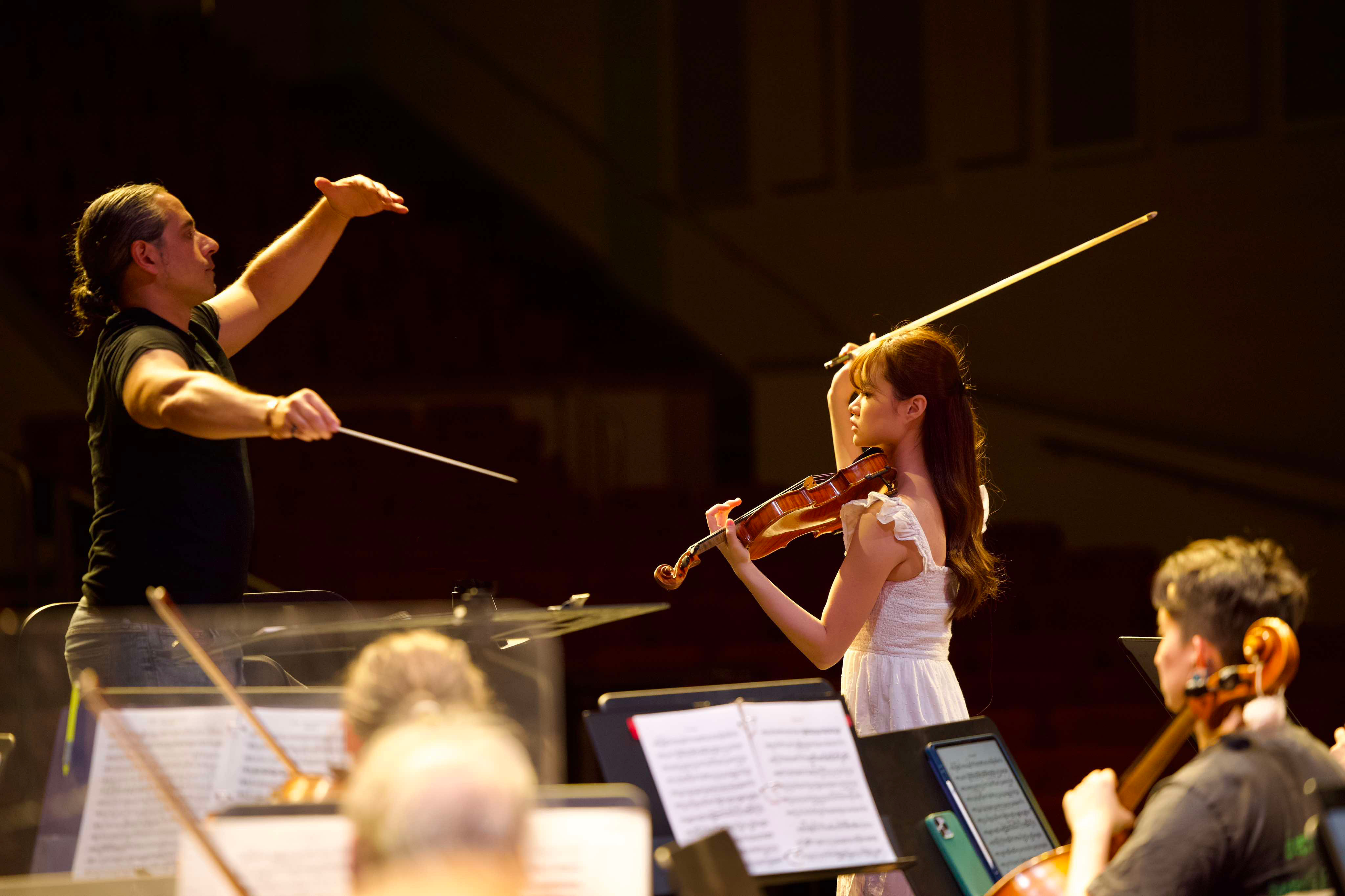
This Saturday, March 29, I will have the pleasure of collaborating with violinist Fiona Cunninghame-Murray as our soloist in Sacramento for Jenö Hubay's Carmen Fantaisie, with the Camellia Symphony Orchestra. I had the chance to ask Fiona some questions, and here are her answers:

Christian Baldini: Fiona, it is a pleasure to be making music with you, especially after hearing so much about you. Welcome! You recently made your debut as a soloist sharing the stage with Joshua Bell in Bach's Double Concerto. Tell us about this experience and how you felt. I imagine he must have been one of your heroes growing up, so how has this experience transformed you?

Fiona Cunninghame-Murray: Thank you so much for having me! My debut with Joshua Bell and Academy of St Martin in the Fields was incredibly transformative. Growing up, he was definitely a figure that I looked up to so it felt surreal to perform with him. Because this concert was sold out and on the subscription series for San Francisco Symphony, I learned a lot about the relationship between preparation and nerves. I was very lucky to have the support of my wonderful teacher Chen Zhao, who made sure that I was prepared for anything and everything on the night of the concert. I am very grateful to have been awarded this opportunity and I hope to grow from here. 

CB: And I understand you have been borrowing a truly special instrument too? Tell us about it, and how it reached your hands.
FCM: Yes, I had the honor of playing on a 1728 Stradivari titled “Caressa, Thunis” generously loaned to me from Bein and Fushi. Playing on that instrument taught me a great deal about violin playing and it has been incredible to perform on a piece of history. 

CB: Who have been your most important mentors, and why?
FCM: My teacher Chen Zhao has been an incredible mentor to me. I have only known him for a year but in that time I have grown so much as a musician in terms of artistry and experience. He has gone above and beyond for me in order to make sure that I am the best that I can be. I also need to mention my father because he was my first and longest running mentor. Although he is not a classically trained musician, he spent the last two decades learning alongside me in order to support me. I am very grateful for everything that he has done for me.

CB: What are your earliest musical memories? How did it all start for you?
FCM: Music has always been in my family. One of my uncles was a theory teacher at the Royal Irish Academy of Music and another performs traditional Irish music in a band. My father plays the piano and accordion as well. I began playing the violin at age 3. My mother had a full sized violin, bigger than I was at the time, and I gravitated towards it. I was lucky enough to be enrolled in lessons for both classical and Irish traditional music and it went from there. 

CB: What would be your advice for young musicians? In particular, how do you deal with frustration or adversity?
FCM: When I feel frustration in the practice room, I know I am doing something right. In order for performing to be enjoyable and free, practicing must consist of hard work and sometimes hard work can feel frustrating. A lot changed for me when I learned to push through my frustration and be patient with the learning process. 

CB: Who are your favorite composers/works, and why?
FCM: This is a hard question! For violin repertoire, I am a fan of exciting show pieces, which is why Carmen is perfect. In terms of symphonic repertoire I love Rachmaninov and Shostakovich, for example Isle of the Dead and Shostakovich’s Piano Concerto no. 1. I spend a lot of time listening to French Impressionism, especially for solo piano repertoire and chamber music. There is so much incredible music out there it is impossible to pick just one. 

CB: Tell us about Hubay and his extraordinary Carmen Fantaisie. What should people listen for in this piece?
FCM: Carmen, the opera, is an iconic work that has infiltrated almost every instrument’s repertoire. For violinists, there are three well-known Fantasies each with their own set of challenges and excitement. The Hubay Carmen is less frequently played in comparison to both Sarasate and Waxman’s. If you are familiar with the opera, you will hear the motifs weaved into the technical passages. It can be fun to pick out the melody in these sections. Often during these passages, I am focusing on the melody instead of each individual note. 

CB: What's your most memorable orchestral experience? Any fun facts to share? 
FCM: My recent debut is my most memorable orchestral experience. I have always loved performing and not only was that my biggest concert to date, it was also the most fun I have ever had!

CB: Thank you Fiona, I look forward to making music with you and introducing you to our audience members!
FCM: Thank you so much, I am honored to collaborate with you and the incredible members of this orchestra!


Violinist Fiona Cunninghame-Murray, a rising talent born in Marin and raised in Baltimore, studied at the Peabody Pre-Conservatory with Lenelle Morse and earned her Bachelor's degree under David Halen, Concertmaster of the St. Louis Symphony, at the University of Michigan. Currently, she is pursuing her Master's degree at the San Francisco Conservatory of Music, studying with Chen Zhao, violinist of the San Francisco Symphony.

During her summers, Cunninghame-Murray has participated in prestigious music festivals, including the Meadowmount Festival, where she studied with Gerardo Ribeiro, Sally Thomas and Kikuei Ikeda of the Tokyo String Quartet, and the Aspen Music Festival under Robert Lipsett. Her performances include sharing the stage with Gil Shaham and the Aspen Festival Orchestra and collaborating with Wynton Marsalis and the Jazz at Lincoln Center Orchestra.

Cunninghame- Murray has also participated in masterclasses with distinguished artists Hilary Hahn, Midori Goto, Daniel Ashalamov of the American String Quartet and Daniel Phillips of the Orion String Quartet.

Fiona Cunninghame-Murray recently made her debut with Joshua Bell and the Academy of St. Martin in the Fields in this special program presented by the San Francisco Symphony as part of the Great Performers Series.

Elisa Jeon in Conversation with Christian Baldini

This Saturday, March 29, I will have the pleasure of collaborating with violinist Elisa Jeon as our soloist in Sacramento for Ernest Chausson's Poème, with the Camellia Symphony Orchestra. I had the chance to ask Elisa some questions, and here are her answers:


Christian Baldini: Elisa, welcome! I look forward to performing this beautiful work with you, and I can't wait to share your talents with our audiences. Tell me, if you could describe Poème in one sentence, what would that be? And how do you personally interpret the overall character and emotional arc of this piece? Do you envision a particular narrative or imagery while performing this work?


Elisa Jeon: Thank you for having me! If I were to describe Poème in one sentence, I’d say it evokes a sense of unease and anguish, yet also feels lovestruck and dreamy, capturing the emotional intensity and complexity of a love story. Since Poème is inspired by Ivan Turgenev’s novella Le chant de l’amour triomphant, certain sections of the music bring to life the imagery and emotions of the narrative. As I perform, I’ll draw from these elements to convey the emotional journey of the love story through the music.


CB: What makes Poème so emotionally powerful? Is it the harmony, the phrasing, or something deeper?

EJ: Poème is so emotionally powerful because Chausson creates a unique sound world that’s both rich and intimate. The lush harmonies and the way he builds tension make the music feel like it’s constantly searching for something, which gives it a deeply emotional pull. The connection to violinist Eugène Ysaÿe, for whom the piece was written, is also key. Ysaÿe’s virtuosity really influenced how Chausson wrote for the violin, allowing for a personal, expressive interaction between the violin and the orchestra. That partnership helped shape a piece that feels both personal and universally moving.


CB: What is your approach to rubato in general, and in particular in the opening section of this piece? How do you shape the long phrases, and where do you prefer natural breathing points or slight hesitations?

EJ: My approach to rubato is about trying to imitate human emotion and, in some ways, speech. Just as our phrasing in conversation shifts depending on what we want to express, I bring that same flexibility to the music. In the opening of Poème, for example, I pay close attention to the emotional arc of each phrase. If I’m conveying longing, I might stretch a note or pause to let that emotion linger. Similarly, if the emotion is more urgent or intense, I’ll push forward slightly. It’s all about finding where those breathing points and hesitations feel natural, though it can take a bit of trial and error to discover the right moments and balance. It’s a constant process of listening and adjusting, and when it clicks, the music feels more alive and convincing.


CB: Who is your favorite violinist interpretation of Poème, and why?

EJ: Janine Jansen’s interpretation of Poème is my favorite, although there are many other wonderful performances to appreciate. This piece offers plenty of room for freedom, especially in the first two cadenzas, which gives each soloist a chance to make it their own. However, Jansen takes it to another level. I find her playing to be incredibly human, there’s a depth and sincerity in her phrasing that makes the already emotional piece even more profound. Every note she plays feels so intentional, and it’s almost as if she gives words to the music. There’s a daring quality to her performance, a kind of visceral emotion, and even a bit of attitude in how she approaches certain moments. That unique combination of intensity and boldness makes her interpretation stand out in such a compelling way. 


CB: What is the meaning of music to you personally, in your life? How did it all start for you?

EJ: For me, music is about connection, it's a way to share something deeply personal and express emotions that words can’t quite reach. It’s also about creating beauty, whether on my own or with others. My journey started with piano, and then I picked up both piano and violin. But I ultimately chose the violin because I loved playing in orchestras and being part of that community. That’s what really kept me drawn to it.


CB: What's the best advice you've ever received from a mentor or teacher?

EJ: The best advice I’ve ever received is to have fun with the music! I used to get so caught up in hitting every note perfectly that I’d forget the most important thing… It's about making music, not just playing the right notes (although that’s important too). Once I started focusing more on the feeling and expression, everything opened up and became so much more rewarding and enjoyable.


CB: Thank you very much Elisa, we look forward to making music with you!

EJ: Thank you! I’m really looking forward to making music together and sharing this experience with all of you.


Elisa Jeon is an accomplished violinist currently pursuing her studies at the San Francisco Conservatory of Music. A dedicated performer, Elisa has earned recognition for her artistry through performances with prestigious ensembles, including the New World Symphony as a substitute violinist and the National Orchestral Institute Festival Orchestra under Marin Alsop, where she served as Assistant Concertmaster. 


Elisa’s commitment to expanding her musical range has also led to performances at renowned summer festivals, as well as featured recordings under the NAXOS Recording Label. She has played with the San Francisco Conservatory of Music Orchestra and served as a violinist with the American Youth Symphony from 2018 to 2021.


Currently studying with Chen Zhao of the San Francisco Symphony, Elisa continues to refine her craft, working toward a degree in Violin Performance.


Thursday, December 5, 2024

Rena Harms in Conversation with Christian Baldini

I recently sat down with soprano Rena Harms to discuss her upcoming performance of Poulenc's Gloria which she will perform as our soloist with the Camellia Symphony Orchestra in Sacramento, together with the Sacramento City College Choirs. The performance is this Saturday, December 7, 2024, at 7:30pm. Below is our exchange:


Christian Baldini: Rena, it will be a pleasure to make music with you for the first time. Tell me, what are some of the moments you love the most about Poulenc's Gloria, and why? What should people listen for in this piece?


Rena Harms: I love Poulenc. The first full role I ever sang was Mere Marie in Poulenc’s Dialogues of the Carmelites in college. Poulenc has such a distinct sound and I love the moments in the Gloria that make me say “wow, that was so beautifully and quintessentially Poulenc.” I also love his use of dynamic contrast. 

CB: How were your beginnings with music? Who have been your most important mentors, and why?


RH: I grew up in a musical family and always knew I wanted to be a performer. I did my first play when I was 4 and acted, sang and danced all the way through high school. I went to Manhattan School of Music for my undergraduate degree and fell in love with opera. My most important mentor is Marilyn Horne. She has been my biggest advocate, hero and friend throughout my career. In my early career I was in the young artist program in LA and was hand picked by Placido Domingo. He definitely played a big role in my career as well. He conducted my first Mimi in La Boheme, which I jumped in for with no rehearsal on stage or in costume. It was a life changing experience!

CB: Which composers inspire you the most? And which works suit your voice the best? Somewhat connected to this: how has your voice changed over time, and has that influenced your repertoire choices?


RH: I love to sing Verdi and Strauss the most. The way they wrote for the voice is unsurpassed. Puccini sings to my soul and is my favorite to perform. He writes ever emotion into the score. It is an actress’ paradise! I think my voice is especially suited for Czech composers but those operas are unfortunately not programmed so much so I have not gotten to sing some of my most coveted roles (Rusalka and Jenufa!) All voices mature and change but one of my biggest challenges in my early career was having to say not to things my teacher and Marilyn Horne thought were too soon. I said no to 5 Toscas before I was 25! I worked very hard in my career to say yes to things that I could sing with integrity in my voice. 

CB: You are both active in the concert stage, as well as the operatic world. What are some of the main differences in your view, and what are your personal preferences?


RH: The main difference for me is that in a concert you get to concentrate much more on the music because that is the totality of what is being asked of you.There is nothing I love more than singing a role in an opera, to tell a story and take an audience on a journey but there are so many other things going on that I find sometimes the importance of enjoying the beauty of the orchestra and voices can be forgotten.  In a concert performance one gets to put all of the energy into the making music together. 

CB: Thank you for your time Rena, I look forward to bringing this beautiful music by Poulenc to life with you as our soloist!


RH: I can’t wait! 


Thursday, September 19, 2024

Catherine (Shin-Rou) Lin in Conversation with Christian Baldini

On September 28, I will have the pleasure of conducting Brahms' Violin Concerto with Catherine Lin as our soloist with the Camellia Symphony Orchestra in Sacramento. Also on the program are Daniel Godsil's "Cathedral Grove" and Shostakovich's Symphony No. 1. Below is an interview with Catherine. (click here for ticket information)

Christian Baldini: Catherine, welcome, and let's start by talking about Brahms. What do you like the most about this concerto? Why is it special? What should people listen for in this piece?

Catherine Lin: Brahms is definitely one of my favorite violin concertos. It has a lot of beautiful melodies and lines between the solo violin and the orchestra. Why is this piece special? I think the most interesting thing and unusual thing is Brahms gives the orchestra a very strong role and, not just for the soloist. I highly recommend everyone to listen to the sixteen notes from the orchestra part in the first movement and the beautiful melody in the beginning of the second movement. All the themes can also be heard in the orchestra parts too.

CB: Let's talk about your beginnings with music. Growing up in Taiwan, how did you first encounter the violin? Did you play other instruments as well?

CL: First time I saw the violin was when I was three. My brother was practicing on his violin. I saw it and I told my mom I also want to play this instrument and she said, “Ok, only if you decide to make the violin as your career, otherwise you should just play the piano since I’m a piano teacher.” I was very excited and said yes! I will practice every day. Now, I feel very lucky that I made the right choice.

As for other instruments, as I mentioned, my mom is a piano teacher, so she taught me theory, piano and musicianship (like rhythm and solfège). So I know how to play piano and when I was in middle school, I also learned percussion for a year and that was fun!

CB: Who are some of your favorite composers? And favorite violin concertos?

CL: Paganini, Beethoven, and of course, Brahms. I like many violin concertos, such as Tchaikovsky, Sibelius and Glazunov, but if I have to pick one it will still be the Brahms violin concerto.

CB: Have you played a lot of chamber music as well? Is the experience different from playing as a soloist with an orchestra?

CL: Yes, I’ve played a lot! Playing chamber music is very fun, but it’s different from playing with an orchestra. The size of a chamber group is much smaller. Whereas orchestras have strings, winds and percussions. So they have much larger scale. For chamber music, I think discussion is more important than playing; you need to spend time discussing how to create good music and find compatible partners with similar music ideas.

CB: What's a day like for you? How much do you practice? Do you have hobbies? Do you exercise?

CL: I have a pretty busy life doing my schoolwork at San Francisco Conservatory of Music. I usually practice at least 3 to 4 hours on weekdays and practice more on the weekends. I like drawing and working out when I’m free.

CB: What is your advice for your musicians who are starting out? How does one deal with frustrations? How does one stay positive?

CL: listen carefully and practice slowly are my suggestions. Usually when I feel frustrated, I would find something I like to do like talking to friends or do something I enjoy to do like painting or playing with my cats.

CB: Thank you for your time Catherine, I look forward to making music with you!

CL: Thank you, Maestro for inviting me to play with you and this amazing orchestra!


Catherine Lin rehearsing Brahms with Maestro Baldini and the Camellia Symphony Orchestra


Catherine Shin-Rou Lin, 21, was born and raised in Taiwan. She started playing violin when she was four and now she is currently an undergraduate student at the San Francisco Conservatory of Music, studying with Professor Chen Zhao.
Catherine has participated in several music festivals, including the Beverly Hills Music Festival, where she played for many professors such as Oleh Krysa, Margaret Batjer, and Tamara Chernyak. She also attended the Round Top Music Festival and the Bowdoin Music Festival these past few years. Additionally, Catherine has taken private lessons with renowned violinists such as Ilya Kaler, Nai-Yuan Hu, Keng-Yuen Tseng, Nancy Zhou, and Danny Tzu-Ti Chang.
In addition to her festival experiences, Catherine had a great time with the San Francisco Symphony Youth Orchestra in 2022, receiving excellent guidance from SF Symphony’s members and conductors.


Daniel Godsil in Conversation with Christian Baldini

On September 28, I will have the pleasure of conducting Daniel Godsil's "Cathedral Grove" with the Camellia Symphony Orchestra in Sacramento. Also on the program are Brahms' Violin Concerto with Catherine Lin as our soloist and Shostakovich's Symphony No. 1. Below is an interview with composer Daniel Godsil. (click here for info about this program)

Christian Baldini: Daniel, welcome, and let's start by talking about your music. What was the genesis for Cathedral Grove? Is it different from your other music? What should people listen for in this piece?

Daniel Godsil: One of the things that really inspired this piece was a comment by composer Sam Nichols, my former teacher at UC Davis: he said that orchestral musicwith its relatively bigger scale, ​large performing forces, and sheer number of people working behind the scenesis really a public art. That really resonated with me, and got me thinking about other public spaces like our country's national and state parks. I often visited California's beautiful parks while I was studying at UC Davis, and decided to do an orchestral "sound-painting" of one of my favorites, Muir Woods (of which Cathedral Grove is a part). Around the time I was writing this piece, I was writing a lot of electronic music that used what I called "sound-shapes"...honestly kind of silly, but trying to render in sound very simple shapes like triangles, X-shapes or chiasms, circles, etc., as jumping-off points to start a composition. People can perhaps listen in this piece for big triangles and X-shapesroughly the giant shapes created​ by trees in the Muir Woodsrendered in sound. This piece was also a little different from my other work at the time in that I consciously tried to use more consonant combinations of notes. I often write using a spectrum of dissonant and consonant sound combinations, but for this work I experimented with trending more towards the consonant side of things. 

CB: Let's talk about your beginnings with music. How did it all start for you? Was there a particular "eureka" moment when you decided to become a professional musician?

DG: I started playing guitar at age 11. Throughout junior and high school I played mostly rock music, and (after learning just three or four chords) started forming bands with friends. I was writing tons of new songs and riffs all the time, which really the culture of rock music...everyone was writing their own stuff! I didn't think about it much at the time, but that environment was really teaching me the art of composition. My eureka moment was around the age of 17 when I really fell in love with film music. I realized that the orchestral timbres I was drawn to were difficult to achieve with the more limited pallet of tone-colors in rock, and found a piano teacher, learned how to read music, and more importantly, how to write it down and communicate with lots of other more classically-trained players. 

CB: Who are some of your favorite composers? Why? What do you look for in "new music"?

DG: This is a tricky question! It's often said that the music you learned to love in your adolescence is the music you love for your whole life, and that's definitely true for me. So that's a lot of heavy metal like Metallica, Megadeth, Slayer, Sepultura...and also film scoring in the classic Golden Age style like Erich Korngold, Max Steiner, John Williams, and James Horner. Because of my metal background I love "classical" music with lots of raw energy...Prokofiev, Shostakovich, Beethoven, and more recent composers like Georg Haas, Thomas Ades. And because of my love of film music I love composers who built a lot of drama into their forms...I love Sibelius! I also found myself very drawn to the American Symphonists of the 1930s and 40s who helped form the language that film composers use. Composers like David Diamond, Walter Piston, Roy Harris, and of course Copland. What I look for in new music, I think, really tends toward those two silly adolescent drives...energy and drama! 

CB: What's a day like for you? When is the best time to compose? Do you have hobbies? Do you exercise? How do you balance your life as a Professor with your time to compose and perform?

DG: I'm in my fourth year teaching music at Columbia College, in the foothills of the Sierra close to Yosemite. This job keeps me very busyit's a small school and I'm a department of one! I teach music theory, ear training, music history, private lessons, and I conduct the college orchestra. So I haven't found a lot of time to write much in the last few years while I figured out the job! I'm happy to report that I've (more or less) figured it out and am finding more time now to compose...mostly, for me, in the very early morning before my kids wake up. I'm a diehard hockey fan, and have recently gotten very much into astronomy/telescopes. I am an avid cyclist and exercise often...it's essential for me! It's the best medicine one can get. My job mostly (right now) calls on my performing abilities...I play a lot of piano and guitar (and have been studying jazz very in-depth recently) and have been conducting a lot. I find it very musically satisfying. ​

CB: What is your advice for your musicians who are starting out? How does one deal with frustrations? How does one stay positive?

DG: I always recommend that musicians should develop a very diverse and marketable skill-set...learn to compose! Play several instruments. Get good at video editing. Know how to record with a DAW and know what microphones work for what things. Maybe this doesn't work for everyone, but it does for me: if you get frustrated learning a Beethoven sonata or get composer's block, go learn a jazz standard for fun or go for a walk. 99% of the time that will help you forget your frustration and come back to whatever it was with a positive attitude. 

CB: Lastly, what is the meaning of music to you? I know this is a very big and general question. Feel free to answer it in any way that represents you!

DG: This changes for me a lot, but right now I'm just so grateful to be in a big community of great music makers, be it my students, the talented amateur players in my orchestra, or just friends who play bluegrass for fun. Especially now in this election cycle, there's a big push to look at life through a political lens...how much more fun and positive it is to apply a musical lens instead, and let that focus and inform everything else! 

CB: Thank you for your time Daniel, I look forward to making music with you!

DG: Thanks Christian! Can't wait to work with the wonderful Camellia Symphony! 

Daniel Godsil (Courtesy Photo)

Daniel Godsil's music, which has been described by the San Francisco Classical Voice as having an “intense dramatic narrative,” draws from such eclectic influences as science fiction, thrash metal, and Brutalist architecture. His more recent work draws inspiration from the natural beauty of Northern California, his current home.


Winner of the 2019 League of Composers/ISCM Steven R. Gerber prize (for Cosmographia) and the 2017 Earplay Donald Aird Composition Competition (for his quartet Aeropittura), Godsil's music has been played by Spektral Quartet, Ensemble Dal Niente, Talujon Percussion, Daedalus Quartet, Lydian String Quartet, Empyrean Ensemble, Metropolitan Orchestra of Saint Louis, UC Davis Symphony Orchestra, University Symphony Orchestra at California State University Fullerton, Knox-Galesburg Symphony, Secret String Quartet, and the Nova Singers, among many others. Recent film scores include the PBS documentary Boxcar People, Man Ray’s 1926 silent film Emak-Bakia and the feature film H.G. Wells’ The First Men In The Moon. Godsil was a finalist in the 2018 Lake George Music Festival chamber composition competition, as well as the 2014 and 2019 Red Note New Music Festival Composition Competitions. His choral works are published by Alliance Music Publishing and NoteNova Publishing, and his chamber and orchestral music is published by BabelScores in Paris.

Born and raised in central Illinois, Godsil (b.1982) holds his PhD. in Composition and Theory from the University of California, Davis, where he studied with Pablo Ortiz, Mika Pelo, Laurie San Martin, and Sam Nichols. He holds an MFA in Music Composition from the Vermont College of Fine Arts, where he studied with John Fitz Rogers, John Mallia, and Jonathan Bailey Holland. He also holds a BM in Music Composition from Webster University.

Godsil was selected to participate in the 2017 Summer Institute for Contemporary Performance Practice (SICPP) in Boston, where he had master classes with composers Nicholas Vines and Georg Friedrich Haas.

Godsil has also been active as an educator, conductor, and performer in the central Illinois area, Knox College, Monmouth College, and Carl Sandburg College. At Knox College, he directed the New Music Ensemble, Wind Ensemble, Chamber Ensemble, and Men’s Chorus. He has also held posts as choral accompanist and collaborative pianist, and served as Music Director and Organist at Grace Episcopal Church in Galesburg, IL.  

Godsil is a professor of music at Columbia College in Sonora, California. He has also served as artistic committee president for Ninth Planet New Music, a trailblazing new music ensemble based in California's SF Bay Area. 


Monday, October 30, 2023

Eric Zivian in Conversation with Christian Baldini

On November 4, I will have the pleasure of collaborating with pianist Eric Zivian as our soloist in Beethoven's Piano Concerto No. 4 with the Camellia Symphony Orchestra in Sacramento. Also on the program (aptly titled "Revolutionary Spirits") will be Beethoven's Symphony No. 2, as well as Ruth Crawford Seeger's Andante for Strings. Below is a conversation with Eric.


Christian Baldini: Eric, once more it will be a pleasure to work with you and to make music together. What are some of the things you like the most about this Beethoven Concerto? And what should people listen for in it?


Eric Zivian: It’s wonderful to be back working with you again! The Beethoven Fourth Piano Concerto is a very special piece in the repertoire. It is not stormy or extroverted like Beethoven’s other concertos, but predominantly gentle and lyrical. The slow movement, a dramatic dialogue between the orchestra and piano, is absolutely stunning. In the first movement, Beethoven breaks the usual pattern of concerto first movements and opens with a rhapsodic piano solo before the standard orchestral introduction. I find the ornaments in the piano part toward the end of the movement, after the cadenza, to be some of the most delightful ever written.


CB: Does your interpretation change much as rehearsals go forward? Aside from practicalities, do you feel that rehearsing with others and in different spaces affect your performance or your understanding of a piece? 


EZ: Absolutely. There is nothing like rehearsing with a full orchestra under the direction of an intelligent and sensitive musician like you to give me a fresh perspective. Plus, during practice I always think of new things!


CB: Well thank you, it is truly a wonderful collaboration working with you and receiving so much feedback from you in rehearsals! You also play a lot on the fortepiano. Has this informed how you approach a Beethoven or Mozart Concerto when performing on a modern instrument?


EZ: Very much so. I have a fortepiano modeled on the kind of instrument Mozart and Beethoven would have known. It has a totally different touch and sound, very articulate in all registers with deep bass notes, bringing out the clarity of the counterpoint. With that sound in my ear, I have learned to emphasize those qualities on the modern piano when playing 18th and 19th-century music.


CB: You also love the music of Brahms, and of Ligeti. What attracts you so much to their music, and why?


EZ: Although Brahms and Ligeti were very different composers, I love their music for much the same reason: they use complex rhythms that appeal to my sensibility, while at the same emphasizing clarity and directness of expression.


CB: As a composer, what are some of your priorities, and/or what do you try to achieve with your own music?


EZ: To be fully transparent, I haven’t written music in some years. But in my composing days, I also aimed to write music that reflected a combination of rhythmic intricacy and straightforward expression. Decades of composing music also helps me, as a performer, to gain insight into the composer’s perspective.


CB: What would be your advice for young pianists and for young composers? What is your advice when people lose hope or get frustrated with themselves?


EZ: My advice is: always remember what drew you to performing or composing. By all means listen to the valuable advice of your teachers and mentors, but stay true to your own vision of what music is all about. During performance, or the creative process, relax and let the music flow through you.


CB: Thank you Eric, I am very much looking forward to our performance together!


EZ: Thanks Christian, I can’t wait!


ERIC ZIVIAN

 Eric Zivian received music degrees from the Curtis Institute of Music, the Juilliard School and the Yale School of Music. He studied piano with Gary Graffman and Peter Serkin and composition with Ned Rorem, Jacob Druckman, and Martin Bresnick.

Eric is equally at home on modern and period instruments. He is Music Director of the Valley of the Moon Music Festival, a festival in Sonoma specializing in Classical and Romantic chamber music played on period instruments, and a longtime member of the Left Coast Chamber Ensemble in San Francisco.

Eric recently performed the Mozart C minor Concerto with the Portland Baroque Orchestra and the Beethoven Choral Fantasy with the Philharmonia Baroque Orchestra. At the height of the pandemic, Eric livestreamed all 32 Beethoven piano sonatas on period pianos.


Monday, April 24, 2023

Anyssa Neumann in Conversation with Christian Baldini

On April 29, 2023, Anyssa Neumann will perform the Piano Concerto No. 1 by Franz Liszt with the Camellia Symphony Orchestra in Sacramento. I will have the honor of conducting this beautiful program, which also includes Florence Price's Andante moderato, and Lutoslawski's Symphony No. 4. Below is an interview with Anyssa, who is visiting from the United Kingdom.


Christian Baldini: Anyssa, please tell us what is so special to you about this particular concerto? What should people listen for in it?

Anyssa Neumann: My favourite pieces seem to be the ones I've heard great performances of, and this is no different. I vividly remember hearing a friend perform the Liszt E-flat concerto with orchestra when I was 18, and it was love at first listen. It's such a fun concertoserious music that doesn't take itself too seriously, full of spark and fire and shimmering magical fairylands. And it moves between sections so rapidly that you can't get bored. This concerto sometimes gets a bad rappeople think it's too flashy and shallow, not substantial enough. I disagree. Liszt as composer (rather than pianist) often took a beating from the critics, and he agonized over finalizing his written works before subjecting them to public scrutiny. This concerto, on which he worked for 25 years, starts with a stentorian theme in the strings and winds, a nine-note phrase to which he (and possibly his son-in-law Hans von Bülow) later attached the words, “Das versteht Ihr alle nicht, haha!” (“None of you understand this, haha!”) in rebuttal to those critics. A musical cocking-a-snook, as the Brits say!


CB: How were your beginnings with music? I know you also played the trumpet when you were growing up. Was there a time when you played both instruments with equal emphasis? When/how/why did you decide to quit the trumpet in favor of the piano?


AN: I hated the piano for most of my childhood. I wanted to play the violin, but my parents wouldn't let me (to be fair, beginner violin isn't the most melodious of sounds). When I was 9, I decided to play trumpet in the school band (thrilling my parents, no doubt). I liked trumpet much more than piano, but I was quite happy playing second (or third) chair. To be a professional brass player, you have to really want to be in the spotlight, to play all those high notes. I didn't. But trumpet allowed me to be part of a musical community in a way that solitary piano never did. I played trumpet in the Sacramento Youth Symphony from ages 11-16, and that, more than anything else, kept me interested in and engaged with classical music during my piano-hating years.


CB: What does music mean to you? How does music (and more specifically classical music such as the Liszt Concerto) fit into today's society?


AN: Good grief, where to start?! I think I'll paraphrase what an old teacher of mine once said: "a life with music is better than a life without." I have thought about changing careers many times, doing something that actually pays well, something I can leave at the office. (Fact: musicians don't get weekends.) But the thrill of making music, the portals that these sounds open up to other times and places, that feeling of emotional and physical aliveness, and that communal experience with other musicians and audienceswell, you can't beat that.


CB: You grew up in Sacramento, played trumpet in the Sacramento Youth Symphony while growing up here, and you have now been based in the UK for a while. What are some of the things you miss (if any) about living in the US?


AN: Old-fashioned donuts. Deli sandwiches. Mexican food. In that order. I also miss the wonderfully varied landscape and the smell of summer. And, of course, my friends and family.


CB: Besides being a wonderful concert pianist you are also a musicologist, and an Ingmar Bergman scholar.  You are currently completing a Postdoc at Uppsala university in Sweden. How do you manage it all? Would you mind sharing some thoughts about your Ingmar Bergman work?


AN: Most of the time it feels like I'm not managing any of it! Once the pandemic hit, I was very glad that I hadn't put all my eggs in the performing basket—I actually had an academic job during many of those fallow months when musicians suffered the most. Becoming a musicologist was sort of accidental. I was interested in academiaand being a student was the only way I could get visas to live in other countries. So I just kept climbing the degree ladder until I finished a PhD. I fell into Bergman by way of Bach's Goldberg Variations, which Bergman uses in his film The Silence (1963). I wrote a paper on it, discovered that nobody else (at the time) had written much about Bergman's use of music, and that if I ever did a PhD, that would be my topic. I love cinema, I love storytelling—stories are how I make sense of the world. So studying the interaction of film and music was a natural fit for me.


CB: Do you have any advice for young musicians? At certain times in life we all face challenges, competition, and many musicians have thought of quitting more than once. What has helped you in your trajectory, and inspired you to keep going forward?


AN: It's a tricky one, giving advice. I'm not sure I have anyonly a few statements I find to be true. The classical music industry can be absolutely brutal. The pay is crap, the work is relentless, your dreams of soloist stardom will probably come to naught, and you will struggle with feelings of inferiority and failure throughout your entire career. If you don't want to do it anymore, then don't—it's ok to do something else. In fact, if doing something else makes you happier, do that instead! I'm selling it well, aren't I? The important part is this: you don't have to be a full-time professional musician to play or enjoy music. Music is for everyone. It's part of our legacy on this planet. It's the best of humanity. So take it seriously, learn it, listen to it, play it, understand it, make it part of you, pursue a career in it if that's what calls to you. I think we sometimes get so caught up in the competitive culture of classical music—the commercialism, the perfectionism, the comparisons, the number of likes and listens—that we forget what music actually is: a way of communicating something about the beauty and urgency of life. I love what Donna Tartt writes in her novel The Goldfinch about the lasting qualities of art: “And in the midst of our dying, as we rise from the organic and sink back ignominiously into the organic, it is a glory and a privilege to love what Death doesn't touch. For if disaster and oblivion have followed this [art] down through time—so too has love. (...) It exists; and it keeps on existing.” A glory and a privilege—gets me every time. 


CB: Lastly, what are some of the most inspiring experiences (or people) in your life, and why?


AN: My most inspiring experiences have come from artist residencies, particularly those at the Banff Centre in CanadaGetting to know other musicians (or artists more generally), working and living alongside them—with the right people and the right surroundings, an alchemical transformation occurs, of excitement, solidarity, support, understanding, openness, inspiration, collaboration, realness. I'm inspired by people who are real, who don't hide behind a facade of perfection or control (even as I type this I feel the need to maintain my own facade!). Obviously, vulnerability can be uncomfortable, so there's a time and a place, and trust is essential, but...we're all human. We all make mistakes, in music, in life. We all feel, at various times, that we have no idea what we're doing. Can't we just be honest about that? We're all in the same boat. It's better to journey together than not.


CB: Thank you very much Anyssa, we very much look forward to featuring you as our soloist!


AN: Thanks for having me!


Raised in Sacramento and based in the UK / Sweden, pianist Anyssa Neumann has been praised for the “clarity, charm, and equipoise” of her performances, which span solo and collaborative repertoire from the Baroque to the 21st century. Recent highlights include concerto performances with the NYKO Sinfonietta (Sweden) and the Lompoc Pops Orchestra (USA); Bach’s Goldberg Variations in Sweden and Norway; solo recitals in Rome, London, Uppsala, the Pacific Northwest, and throughout California; and artist residencies at the Banff Centre (Canada), Avaloch Farm (USA), and the Bergman Estate (Sweden). During the Covid-19 pandemic, she video-recorded Bach’s Goldberg Variations at home, calling the project #IsolationVariations; the playlist of all 32 videos, accompanied by short essays, can be found on YouTube.


Recent projects include a Don Quixote-inspired song program with British bass-baritone Timothy Dickinson and a concert tour of New Mexico and California with American soprano Rena Harms. Other collaborative partners include soprano Emma Tring (BBC Singers), mezzo-soprano Katherine Nicholson (BBC Singers), violinist Yolanda Bruno (Toronto Symphony), cellist Sara Sant’Ambrogio (Eroica Trio), and the London Chamber Collective. She has also performed as guest pianist with the Sheba Ensemble and appeared on NPR’s Performance Today, Sirius Satellite Radio, Swedish Radio P1 Kultur, Estonia National Radio, and David Dubal’s radio program The Piano Matters, which featured her solo debut album of works by Bach, Beethoven, Messiaen, and Prokofiev.


After studying with Natsuki Fukasawa and Richard Cionco in Sacramento, Anyssa attended the Manhattan School of Music (BM) and University of Oxford (MSt) before continuing further studies with Fabio Bidini in Berlin and Paul Stewart at Université de Montréal. She has additionally worked with Thomas Adès, Rita Wagner, and András Keller at IMS Prussia Cove, and with Mitsuko Uchida, Anne Sofie von Otter, Bengt Forsberg, Marc Durand, Julian Martin, Ronan O’Hora, Anton Kuerti, Andre-Michel Schub, Joseph Kalichstein, and Russell Sherman in master classes.


She earned her PhD in musicology from King’s College London in 2017, focusing on pre-existing music in the films of Ingmar Bergman, which she then developed into a lecture-recital and presented in Los Angeles, San Francisco, Toronto, London, Madrid, Helsingborg, Lund, Uppsala, and Fårö, culminating in a live broadcast from the Arvo Pärt Centre in Laulasmaa as part of the Tallinn Black Nights Film Festival in 2021. She currently holds a postdoctoral position in the Engaging Vulnerability Research Program at Uppsala University. For more information, please visit www.anyssaneumann.com.