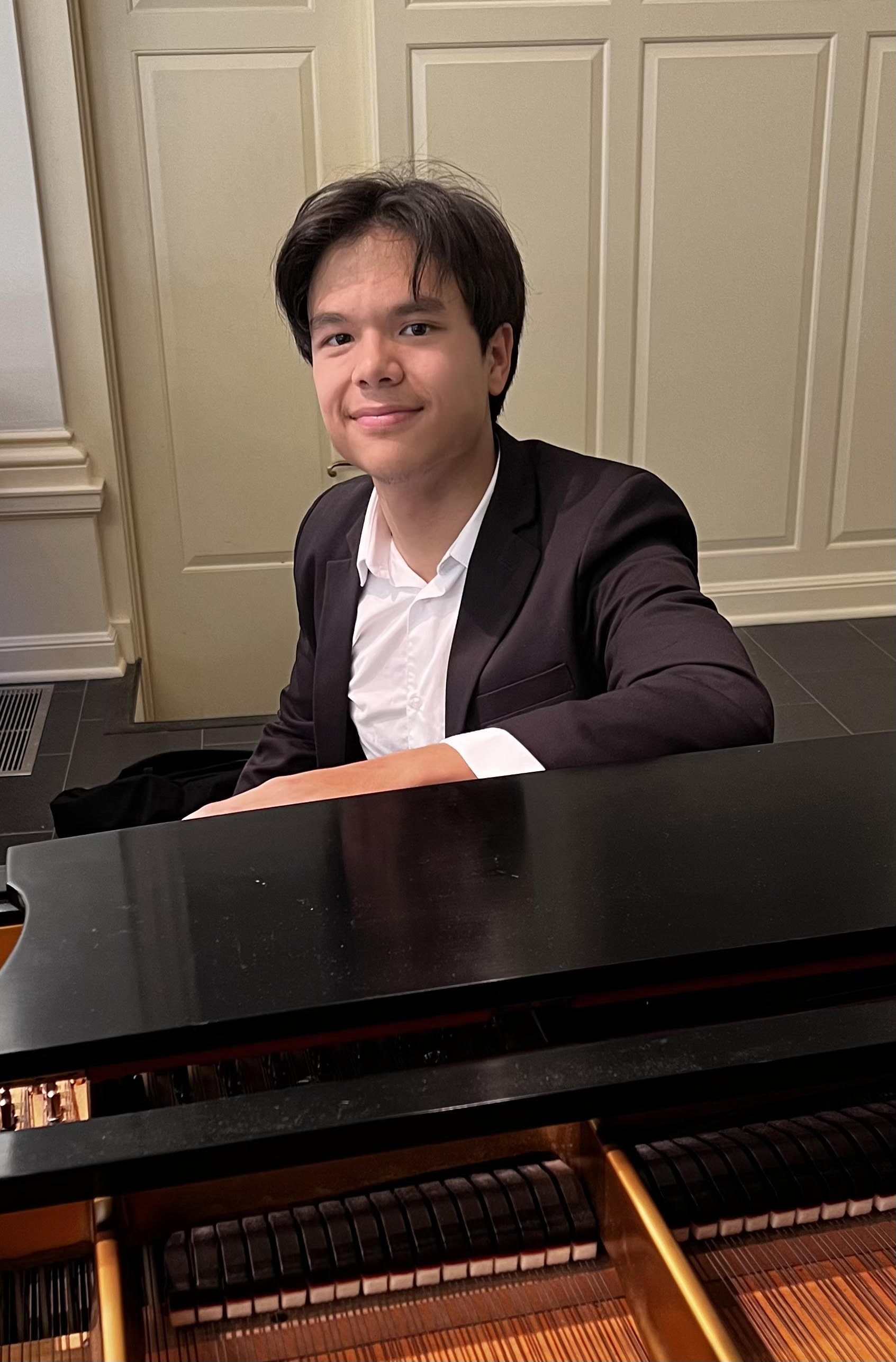
Showing posts with label Pianist. Show all posts

Monday, March 11, 2024

Salomé Ospina in Conversation with Christian Baldini

On March 17, I will have the pleasure of conducting the Grieg Piano Concerto with Salomé Ospina with the Camellia Symphony Orchestra in Sacramento, as part of our "Rising Stars" concert series. On the same program we will also feature the Sibelius Violin Concerto with Suni Norman. Below is an interview with Salomé:


Christian Baldini: Salomé, welcome, it has been very fun to have you in rehearsals with us and to make music with you. Tell us, what are some of your favorite things about the Grieg Piano Concerto? What would you say to someone who's never listened to it? What should they listen for? What will they encounter in this music?

Salomé Ospina: Thank you so much for having me! It has been an honor to play with the Camellia Symphony orchestra and you for the past couple of weeks. I honestly love every single moment in the Grieg concerto. One of my favorite moments in the entire piece is during the slow part of the third movement. I have a solo with the first cello accompanying me as well during this section. I was actually unaware that it was only the first cello until the first rehearsal with the orchestra. This is so meaningful to me because my mother, Maria Hoyos, plays first cello in this orchestra. This duet is so beautiful and I believe it encapsulates all the love and support she has given me over the years. I also really enjoy the last two sections of the third movement because this is the "grandioso" section of the piece. I get to accompany the brass players for a great solo and it is the moment where the tension from the entire piece is finally released. I would describe this piece as adventurous and beautiful. I would listen to the recurring themes especially in the first and third movement. They are everywhere! They get subtly changed throughout the piece but are truly resonant. They will encounter a beautiful journey through this music. I hope that they really enjoy this piece!

CB: You started playing the piano as a young child. Who have been your most important mentors, and why?


SO: Some of my most important mentors have been: Kirsten Smith, Helen Mendenhall, Tatiana Scott, Betsy Collins, and Joe Gilman. They have all guided me for many years with private instruction and are one of the main reasons that I am where I am today musically. They have really helped me develop my technique and love for music as well. I am so grateful to have had these wonderful people in my life.


CB: What are other works and other composers you love playing,  and why?


SO: I really enjoy playing Brahms and Chopin because their harmonic structure is just so beautiful. Also the storytelling that goes on within their pieces is incredible. I recently played the Brahms Piano trio no. 1, and it was incredible because of the complex harmonies and especially because of the interaction between the strings and the piano as well. I also really enjoy listening to Sibelius’s Symphony no 5. 


CB: Do you play other instruments? Do you branch out into other music styles besides classical?


SO: I do not play any other instruments. My mother tried to teach me cello at the age of three, but I decided that piano was what I preferred. I am deeply passionate about playing jazz as well as classical. I love to play in both combos and big bands and I am starting to begin composing as well! I also enjoy playing a variety of styles from latin america with my parents such as boleros, cha-cha-cha, salsa, and many more! I love to listen to music by Hector Lavoe, Duke Ellington, Oscar Petterson, Oscar De Leon and many more!


CB: What is a typical day like for you? How much do you practice in addition to all your other activities? You are still in high school, right?


SO: I am actually still a junior in high school! I typically spend my time in jazz band and concert band at school as well as in some other challenging classes. I typically go home after lunch time at school and usually have a rehearsal with a jazz combo or a private lesson. I try to practice for 2 to 3 hours in a day, but it really depends on how much schoolwork I have. I love to spend time on the weekends with my friends as well. 


CB: What are your plans for the future? Where would you like to see yourself in ten years?


SO: I hope to become a music teacher or a French or Spanish teacher. I really am not sure about where I see myself in ten years. I can envision myself branching out into many things. However, I see myself the most as a teacher of some sorts, and hope to be a performer on the side. 


CB: Both of your parents are musicians, right? Your mother is of course Maria Hoyos, our wonderful principal cellist with the Camellia Symphony. I am sure it will be extremely special to both of you to be playing this concert together. How has it shaped you to come from a musical family?


SO: Being around music constantly is such a privilege for me. I am so grateful to have such wonderful, loving parents. My mom plays cello with the Camellia Symphony and my dad plays saxophone and flute. Being around parents that are practicing exposed me to so much music from a young age and inspired me to become who I am now. This concert means so much to both of us and I can’t believe that I am going to be able to play as a soloist in a concert with my mom as the first cellist. This has been my mom’s dream for many years now, and I am very excited to be playing!


CB: Are you fully bilingual? How have languages shaped or influenced you as a person and as a musician?


SO: Yes, I actually only speak Spanish at home with my parents! Being around two different cultures at once has influenced my view on the world and especially on my values. I try to get the best from both cultures and try to often combine values in order to try to achieve a more balanced lifestyle. I have been introduced to so much music because of them and because of that, I have a love for many different genres. 


CB: Thank you Salomé, I look forward to making music with you and sharing your talents with our audience in Sacramento very soon!


SO: Thank you for this opportunity and for having me!


Salome Ospina is a junior at Rio Americano High School. She currently studies with Kirsten Smith for classical piano and Joe Gilman for jazz piano. She has also previously studied with Helen Mendenhall, Tatiana Scott, Betsy Collins, and Craig Faniani.


Salome debuted as a soloist with the Saint Saens Piano concerto no 2 in November 2022 with the “Sinfónica Joven de Colombia” in Medellin. She has been a part of the Placer County Youth Orchestra, and has performed with the Sacramento Youth Symphony as well. The Summer of 2022, she toured Austria and the Czech Republic with the Rio Americano Jazz and Concert Band. Salome enjoys accompanying other students for performances. 


In February, she went to New York to participate in the Charles Mingus High School Jazz Competition with a small jazz combo from Rio Americano. Salome is a part of The New Traditionalists, a jazz combo that has gone to perform in Orlando and New Orleans. In 2023, Salome was selected as one of 6 people nationwide for the Monterey Next Generation Women in Jazz Combo. This group had the opportunity to perform at the Monterey Jazz Festival in September 2023 and Berklee College Music January 2024. Salome was chosen as one of the winners for the 2024 National YoungArts Award for jazz piano. 


Monday, October 30, 2023

Eric Zivian in Conversation with Christian Baldini

On November 4, I will have the pleasure of collaborating with pianist Eric Zivian as our soloist in Beethoven's Piano Concerto No. 4 with the Camellia Symphony Orchestra in Sacramento. Also on the program (aptly titled "Revolutionary Spirits") will be Beethoven's Symphony No. 2, as well as Ruth Crawford Seeger's Andante for Strings. Below is a conversation with Eric.


Christian Baldini: Eric, once more it will be a pleasure to work with you and to make music together. What are some of the things you like the most about this Beethoven Concerto? And what should people listen for in it?


Eric Zivian: It’s wonderful to be back working with you again! The Beethoven Fourth Piano Concerto is a very special piece in the repertoire. It is not stormy or extroverted like Beethoven’s other concertos, but predominantly gentle and lyrical. The slow movement, a dramatic dialogue between the orchestra and piano, is absolutely stunning. In the first movement, Beethoven breaks the usual pattern of concerto first movements and opens with a rhapsodic piano solo before the standard orchestral introduction. I find the ornaments in the piano part toward the end of the movement, after the cadenza, to be some of the most delightful ever written.


CB: Does your interpretation change much as rehearsals go forward? Aside from practicalities, do you feel that rehearsing with others and in different spaces affect your performance or your understanding of a piece? 


EZ: Absolutely. There is nothing like rehearsing with a full orchestra under the direction of an intelligent and sensitive musician like you to give me a fresh perspective. Plus, during practice I always think of new things!


CB: Well thank you, it is truly a wonderful collaboration working with you and receiving so much feedback from you in rehearsals! You also play a lot on the fortepiano. Has this informed how you approach a Beethoven or Mozart Concerto when performing on a modern instrument?


EZ: Very much so. I have a fortepiano modeled on the kind of instrument Mozart and Beethoven would have known. It has a totally different touch and sound, very articulate in all registers with deep bass notes, bringing out the clarity of the counterpoint. With that sound in my ear, I have learned to emphasize those qualities on the modern piano when playing 18th and 19th-century music.


CB: You also love the music of Brahms, and of Ligeti. What attracts you so much to their music, and why?


EZ: Although Brahms and Ligeti were very different composers, I love their music for much the same reason: they use complex rhythms that appeal to my sensibility, while at the same emphasizing clarity and directness of expression.


CB: As a composer, what are some of your priorities, and/or what do you try to achieve with your own music?


EZ: To be fully transparent, I haven’t written music in some years. But in my composing days, I also aimed to write music that reflected a combination of rhythmic intricacy and straightforward expression. Decades of composing music also helps me, as a performer, to gain insight into the composer’s perspective.


CB: What would be your advice for young pianists and for young composers? What is your advice when people lose hope or get frustrated with themselves?


EZ: My advice is: always remember what drew you to performing or composing. By all means listen to the valuable advice of your teachers and mentors, but stay true to your own vision of what music is all about. During performance, or the creative process, relax and let the music flow through you.


CB: Thank you Eric, I am very much looking forward to our performance together!


EZ: Thanks Christian, I can’t wait!


ERIC ZIVIAN

 Eric Zivian received music degrees from the Curtis Institute of Music, the Juilliard School and the Yale School of Music. He studied piano with Gary Graffman and Peter Serkin and composition with Ned Rorem, Jacob Druckman, and Martin Bresnick.

Eric is equally at home on modern and period instruments. He is Music Director of the Valley of the Moon Music Festival, a festival in Sonoma specializing in Classical and Romantic chamber music played on period instruments, and a longtime member of the Left Coast Chamber Ensemble in San Francisco.

Eric recently performed the Mozart C minor Concerto with the Portland Baroque Orchestra and the Beethoven Choral Fantasy with the Philharmonia Baroque Orchestra. At the height of the pandemic, Eric livestreamed all 32 Beethoven piano sonatas on period pianos.


Monday, September 18, 2023

Parker van Ostrand in Conversation with Christian Baldini


On September 23, I will have the pleasure of conducting Prokofiev's Piano Concerto No. 3 with the wonderful young pianist Parker van Ostrand. This will be in Sacramento (California) with the Camellia Symphony Orchestra, in a program that will also feature Brahms' Second Symphony, as well as Midnight Stirring by Nancy Galbraith. Below is an interview with Parker.
 
Christian Baldini: Dear Parker, it is a pleasure to welcome you again in your native Sacramento to feature you as our soloist in Prokofiev's 3rd Piano Concerto with the Camellia Symphony Orchestra. Tell us, how does it feel to come back home and be featured as our soloist?


Parker van Ostrand: I’m really excited. Playing with orchestra is one of my favorite things as a musician, and getting to do it with a great orchestra and conductor makes it even better. And this will be the first time I play Prokofiev 3 with orchestra. It's also nostalgic since I’m performing again at my old high school. The first rehearsal was the first time I went back there since graduating more than two years ago!

CB: The first (and last) time we featured you as our soloist it was within our Rising Stars series, and you played Beethoven's 2nd Piano Concerto. This was four years ago, and you have amassed a number of successes since then, including winning prizes at major international competitions, performing together with Yuja Wang in San Francisco, being named a 2021 U.S. Presidential Scholar in the Arts. How do you feel? What has changed for you?

PvO: I feel really grateful for all the opportunities I’ve had in the last couple years. Playing with Yuja was definitely a highlight because I’ve looked up to her more than almost any other pianist ever since I was a kid. One thing that’s changed with all this experience is I feel more open to being spontaneous on stage. I’m more confident in my musical decisions and style of playing, so I’m able to take more risks and see what ideas I can come up with on the spot. When you let loose and don’t worry so much about being perfect or how other people might judge your playing, performing becomes a lot more fun.

CB: Tell us about Prokofiev, and his Third Piano Concerto. What are some of the things you like the most about this piece, and what should people listen for when you perform it?

PvO: Prokofiev 3 is one of my favorite concertos to play- it’s naughty, sarcastic, even grotesque at times. I love playing this piece because it’s really fun to go all out with making the piece as “rude” and brash as possible. The writing is very virtuosic and even acrobatic at times, so it’s pretty cool to watch from the audience standpoint. Prokofiev himself was rebellious and cocky during his time at conservatory, and this piece perfectly encapsulates that. There’s a lot of conflict between the piano and orchestra parts, and it’s pretty cool to be one person fighting against 100 other people on stage. There’s also moments in the concerto that are nostalgic, smoky, elegant, beautiful–and the fact that these moments are so rare make them even more memorable. Part of the second movement is a variation that has the sounds of a dark, icy Siberian winter. It will give one chills.


CB: When I interviewed you back in 2019, we talked a lot about your practice routine, the meaning of music to you, and also about your goals in life. Have your goals changed? Do you see anything very differently?

PvO: Because so much has happened in the last couple years I could never have expected or planned (musically related), I actually haven’t been one to set specific goals recently. With a career path in music, so much is out of your control except your ability as a musician. So my goal these days is just to be as good as I can be at the piano, and see what happens from there.


CB: Tell us about your education and your main mentors since you finished high school.


PvO: I’ve been at the San Francisco Conservatory of Music since January of 2022, and I’m now working with Garrick Ohlsson and Yoshikazu Nagai. I’ve studied with Garrick since I was 16, and just recently started studying with Yoshikazu Nagai. Knowing Garrick for this long, he’s had a huge impact on me and just been an amazing teacher, mentor, and someone I look up to. I can also say the same about my previous teacher here at the conservatory, Jon Nakamatsu, who I studied with during my first three semesters at SFCM.


CB: Lastly: what are some of the things (anything) that interest you the most outside music?


PvO: I like going to the gym a lot. It’s fun to keep pushing yourself and setting new goals all the time. When I have more time, I love adrenaline activities like riding rollercoasters or jetskis, and also doing challenging hikes. Nowadays, I am also pretty into watching movies, thrillers in particular.


CB: Thank you very much for your time. I look forward to sharing your wonderful artistry with our audience members.


PvO: Thank you! Looking forward.


Parker Van Ostrand currently studies at the San Francisco Conservatory of Music with Garrick Ohlsson and Yoshikazu Nagai.

He recently won the 2023 PianoTexas Academy Concerto Competition and performed with the Fort Worth Symphony Orchestra this past June. In 2022, he won the Gold Medal in the 71st Wideman International Piano Competition and in November, collaborated with Yuja Wang for a two-piano performance at the SFCM Gala. Last summer, he was selected to play in the inaugural G. Henle Verlag Murray Perahia Masterclass in Munich. He also toured with the California Youth Symphony to Eastern Europe last summer with Bernstein’s Symphony No. 2, “The Age of Anxiety.” In 2020, Parker won Third Prize and the Best Sonata Award in the 10th National Chopin Piano Competition, and was one of 20 high school students nationwide named a 2021 U.S. Presidential Scholar in the Arts.

This season, Parker will be performing with the Camellia Symphony, Symphony Parnassus, the South Arkansas Symphony, the Shreveport Symphony, and the San Francisco Conservatory of Music orchestra as winner of their 2023 Concerto Competition. He will also give recitals at the Tutunov Series in Ashland, the Cape Cod Chamber Music Festival, the Washington International Piano Festival, and Gretna Music with violinist Amaryn Olmeda.

Parker is from Sacramento, CA, and previously studied with Linda Nakagawa, Natsuki Fukasawa, Sarah Chan, and Jon Nakamatsu. 


Monday, April 24, 2023

Anyssa Neumann in Conversation with Christian Baldini

On April 29, 2023, Anyssa Neumann will perform the Piano Concerto No. 1 by Franz Liszt with the Camellia Symphony Orchestra in Sacramento. I will have the honor of conducting this beautiful program, which also includes Florence Price's Andante moderato, and Lutoslawski's Symphony No. 4. Below is an interview with Anyssa, who is visiting from the United Kingdom.


Christian Baldini: Anyssa, please tell us what is so special to you about this particular concerto? What should people listen for in it?

Anyssa Neumann: My favourite pieces seem to be the ones I've heard great performances of, and this is no different. I vividly remember hearing a friend perform the Liszt E-flat concerto with orchestra when I was 18, and it was love at first listen. It's such a fun concertoserious music that doesn't take itself too seriously, full of spark and fire and shimmering magical fairylands. And it moves between sections so rapidly that you can't get bored. This concerto sometimes gets a bad rappeople think it's too flashy and shallow, not substantial enough. I disagree. Liszt as composer (rather than pianist) often took a beating from the critics, and he agonized over finalizing his written works before subjecting them to public scrutiny. This concerto, on which he worked for 25 years, starts with a stentorian theme in the strings and winds, a nine-note phrase to which he (and possibly his son-in-law Hans von Bülow) later attached the words, “Das versteht Ihr alle nicht, haha!” (“None of you understand this, haha!”) in rebuttal to those critics. A musical cocking-a-snook, as the Brits say!


CB: How were your beginnings with music? I know you also played the trumpet when you were growing up. Was there a time when you played both instruments with equal emphasis? When/how/why did you decide to quit the trumpet in favor of the piano?


AN: I hated the piano for most of my childhood. I wanted to play the violin, but my parents wouldn't let me (to be fair, beginner violin isn't the most melodious of sounds). When I was 9, I decided to play trumpet in the school band (thrilling my parents, no doubt). I liked trumpet much more than piano, but I was quite happy playing second (or third) chair. To be a professional brass player, you have to really want to be in the spotlight, to play all those high notes. I didn't. But trumpet allowed me to be part of a musical community in a way that solitary piano never did. I played trumpet in the Sacramento Youth Symphony from ages 11-16, and that, more than anything else, kept me interested in and engaged with classical music during my piano-hating years.


CB: What does music mean to you? How does music (and more specifically classical music such as the Liszt Concerto) fit into today's society?


AN: Good grief, where to start?! I think I'll paraphrase what an old teacher of mine once said: "a life with music is better than a life without." I have thought about changing careers many times, doing something that actually pays well, something I can leave at the office. (Fact: musicians don't get weekends.) But the thrill of making music, the portals that these sounds open up to other times and places, that feeling of emotional and physical aliveness, and that communal experience with other musicians and audienceswell, you can't beat that.


CB: You grew up in Sacramento, played trumpet in the Sacramento Youth Symphony while growing up here, and you have now been based in the UK for a while. What are some of the things you miss (if any) about living in the US?


AN: Old-fashioned donuts. Deli sandwiches. Mexican food. In that order. I also miss the wonderfully varied landscape and the smell of summer. And, of course, my friends and family.


CB: Besides being a wonderful concert pianist you are also a musicologist, and an Ingmar Bergman scholar.  You are currently completing a Postdoc at Uppsala university in Sweden. How do you manage it all? Would you mind sharing some thoughts about your Ingmar Bergman work?


AN: Most of the time it feels like I'm not managing any of it! Once the pandemic hit, I was very glad that I hadn't put all my eggs in the performing basket—I actually had an academic job during many of those fallow months when musicians suffered the most. Becoming a musicologist was sort of accidental. I was interested in academiaand being a student was the only way I could get visas to live in other countries. So I just kept climbing the degree ladder until I finished a PhD. I fell into Bergman by way of Bach's Goldberg Variations, which Bergman uses in his film The Silence (1963). I wrote a paper on it, discovered that nobody else (at the time) had written much about Bergman's use of music, and that if I ever did a PhD, that would be my topic. I love cinema, I love storytelling—stories are how I make sense of the world. So studying the interaction of film and music was a natural fit for me.


CB: Do you have any advice for young musicians? At certain times in life we all face challenges, competition, and many musicians have thought of quitting more than once. What has helped you in your trajectory, and inspired you to keep going forward?


AN: It's a tricky one, giving advice. I'm not sure I have anyonly a few statements I find to be true. The classical music industry can be absolutely brutal. The pay is crap, the work is relentless, your dreams of soloist stardom will probably come to naught, and you will struggle with feelings of inferiority and failure throughout your entire career. If you don't want to do it anymore, then don't—it's ok to do something else. In fact, if doing something else makes you happier, do that instead! I'm selling it well, aren't I? The important part is this: you don't have to be a full-time professional musician to play or enjoy music. Music is for everyone. It's part of our legacy on this planet. It's the best of humanity. So take it seriously, learn it, listen to it, play it, understand it, make it part of you, pursue a career in it if that's what calls to you. I think we sometimes get so caught up in the competitive culture of classical music—the commercialism, the perfectionism, the comparisons, the number of likes and listens—that we forget what music actually is: a way of communicating something about the beauty and urgency of life. I love what Donna Tartt writes in her novel The Goldfinch about the lasting qualities of art: “And in the midst of our dying, as we rise from the organic and sink back ignominiously into the organic, it is a glory and a privilege to love what Death doesn't touch. For if disaster and oblivion have followed this [art] down through time—so too has love. (...) It exists; and it keeps on existing.” A glory and a privilege—gets me every time. 


CB: Lastly, what are some of the most inspiring experiences (or people) in your life, and why?


AN: My most inspiring experiences have come from artist residencies, particularly those at the Banff Centre in CanadaGetting to know other musicians (or artists more generally), working and living alongside them—with the right people and the right surroundings, an alchemical transformation occurs, of excitement, solidarity, support, understanding, openness, inspiration, collaboration, realness. I'm inspired by people who are real, who don't hide behind a facade of perfection or control (even as I type this I feel the need to maintain my own facade!). Obviously, vulnerability can be uncomfortable, so there's a time and a place, and trust is essential, but...we're all human. We all make mistakes, in music, in life. We all feel, at various times, that we have no idea what we're doing. Can't we just be honest about that? We're all in the same boat. It's better to journey together than not.


CB: Thank you very much Anyssa, we very much look forward to featuring you as our soloist!


AN: Thanks for having me!


Raised in Sacramento and based in the UK / Sweden, pianist Anyssa Neumann has been praised for the “clarity, charm, and equipoise” of her performances, which span solo and collaborative repertoire from the Baroque to the 21st century. Recent highlights include concerto performances with the NYKO Sinfonietta (Sweden) and the Lompoc Pops Orchestra (USA); Bach’s Goldberg Variations in Sweden and Norway; solo recitals in Rome, London, Uppsala, the Pacific Northwest, and throughout California; and artist residencies at the Banff Centre (Canada), Avaloch Farm (USA), and the Bergman Estate (Sweden). During the Covid-19 pandemic, she video-recorded Bach’s Goldberg Variations at home, calling the project #IsolationVariations; the playlist of all 32 videos, accompanied by short essays, can be found on YouTube.


Recent projects include a Don Quixote-inspired song program with British bass-baritone Timothy Dickinson and a concert tour of New Mexico and California with American soprano Rena Harms. Other collaborative partners include soprano Emma Tring (BBC Singers), mezzo-soprano Katherine Nicholson (BBC Singers), violinist Yolanda Bruno (Toronto Symphony), cellist Sara Sant’Ambrogio (Eroica Trio), and the London Chamber Collective. She has also performed as guest pianist with the Sheba Ensemble and appeared on NPR’s Performance Today, Sirius Satellite Radio, Swedish Radio P1 Kultur, Estonia National Radio, and David Dubal’s radio program The Piano Matters, which featured her solo debut album of works by Bach, Beethoven, Messiaen, and Prokofiev.


After studying with Natsuki Fukasawa and Richard Cionco in Sacramento, Anyssa attended the Manhattan School of Music (BM) and University of Oxford (MSt) before continuing further studies with Fabio Bidini in Berlin and Paul Stewart at Université de Montréal. She has additionally worked with Thomas Adès, Rita Wagner, and András Keller at IMS Prussia Cove, and with Mitsuko Uchida, Anne Sofie von Otter, Bengt Forsberg, Marc Durand, Julian Martin, Ronan O’Hora, Anton Kuerti, Andre-Michel Schub, Joseph Kalichstein, and Russell Sherman in master classes.


She earned her PhD in musicology from King’s College London in 2017, focusing on pre-existing music in the films of Ingmar Bergman, which she then developed into a lecture-recital and presented in Los Angeles, San Francisco, Toronto, London, Madrid, Helsingborg, Lund, Uppsala, and Fårö, culminating in a live broadcast from the Arvo Pärt Centre in Laulasmaa as part of the Tallinn Black Nights Film Festival in 2021. She currently holds a postdoctoral position in the Engaging Vulnerability Research Program at Uppsala University. For more information, please visit www.anyssaneumann.com.


Monday, February 17, 2020

Roger Xia in Conversation with Christian Baldini

Pianist and violinist Roger Xia will be our soloist for Clara Schumann's Piano Concerto on Saturday, February 22 with the Camellia Symphony Orchestra in Sacramento. I had the opportunity of asking Roger some questions, and below are the answers.

Christian Baldini: Roger, it is a pleasure to welcome you back once again with the Camellia Symphony Orchestra. Some years ago, you were our featured "Rising Star", performing concertos on both the violin and the piano. It is so nice to see how much you have developed since those days, and what a mature musician you have become already. Please tell us, what is special to you about performing in the Sacramento and Davis region, where you grew up?

Roger Xia: The Sacramento/Davis region is where I feel most at home and I always love performing for friends and family. I frequently reconnect with old friends, both musicians and non-musicians, at my performances and it’s a joy to catch up with them about our busy lives and future plans. Most of all, I absolutely enjoy inspiring younger children to play classical music, just as I had been inspired and supported by the community.

CB: Tell us about the Clara Schumann Piano Concerto. What is inspiring to you about her? What are some of the features and musical elements that you like the most about this concerto, and what should people listen for while you play it?

RX: For me, the most inspiring element of Clara Schumann’s Piano Concerto is her boldness in incorporating a variety of styles. Some lyrical passages resemble Chopin, while other feisty, technical passages remind me of Liszt. I also like the attacca between the 3 movements of the concerto; the continuation gives the piece a nice flow and creates an unfolding storyline. I hope the audience will enjoy the affirmative and lyrical solo lines in the first movement, the intimate duet with the cello in the second, and the improvisatory, gypsy-like flair in the last movement.

CB: At your young age you've already collaborated with and worked with many wonderful musicians and teachers. Are there any experiences or people that have been particularly inspiring to you?

RX: I’m very fortunate to have started piano lessons with Linda Beaulieu when I was five, and to have continued to study with Dr. Natsuki Fukasawa and professor Richard Cionco for ten years. I’m also grateful to Dong Ho for starting me off on violin when I was six and William Barbini for teaching me during the past seven years. I’d also like to thank Maryll Goldsmith and Michael Neumann for their guidance when I was in the Sacramento Youth Symphony. Many thanks to teachers and staff members at the San Francisco Symphony Youth Orchestra and San Francisco Conservatory of Music Pre-College for continuously helping me develop my artistic potential. I’m also very thankful to Susan Lamb Cook’s continued support in my chamber music learning, Angelo Moreno at my school orchestra coaching. All of these mentors and supporters have inspired me to pursue my lifetime music-making journey.

CB: Why is art important? What is the role of music (and specifically, classical music) in today's world?

RX: Art is something that is unique to humans; it cannot be replaced by robots or AI. It is the most direct expression of the human soul, incorporating kindness, pain, tenderness, ecstasy, and more endless emotions. Music serves as a universal language, an outlet for all these kinds of emotions. As the only audible art form without words, music helps to connect people across the globe with all sorts of backgrounds and portray relatable experiences. Classical music is very unique in the way that it developed alongside music theory and incorporates sophisticated forms like symphonies and operas.

CB: Please tell us about your plans, dreams and wishes for your future. You have managed to continue your remarkable development on both the violin and the piano. What other passions do you have? And now that you will soon embark on your college career, what would you like to do?

RX: In addition to violin and piano, I really enjoy playing tennis and practicing Kung-Fu. moving my body around and breaking a sweat is also a great way for me to clear my mind and serves as a nice break from the academic and musical grind. Every winter, I also go to Lake Tahoe to ski as a mini-vacation with friends and family.
In college, I plan to continue playing piano and violin and participate in chamber music and orchestra ensembles. I’m also really interested in science and would like to simultaneously study academics at a university. Ultimately, I hope to combine music with science to help others.

CB: Thank you so much for your time, and we wish you all the best in your future, which will undoubtedly be remarkable. We look forward to sharing your astonishing talent with our audience very soon.


RX: Thank you Maestro Baldini and the Camellia Symphony Orchestra for inviting me back, and I’m looking forward to another great collaboration and performance!

Roger Xia, Photo by Carlin Ma

Roger Xia, Photo by Carlin Ma


Roger Xia, age 17, a senior at Davis Senior High School (DSHS), is also a San Francisco Conservatory of Music (SFCM) Pre-College scholarship student.                                                                                                                                  

         Roger started piano studies at age 5 with Ms. Linda Beaulieu and continues with Dr. Natsuki Fukasawa and Professor Richard Cionco.  He took violin lessons at age 7 with Mr. Dong Ho and continues with Mr. William Barbini.  At age 10, Roger made his Carnegie Hall debuts as first prize winner of the American Fine Arts Festival (AFAF) Golden Era of Romantic Music International Competition and the American Protégé International Music Talent Competition.  He won top prizes in Pacific Musical Society (PMS), Music Teacher Association of California (MTAC), United States Open Music Competition (USOMC), CMTANC/USIMC International Youth Music Competition, Diablo Valley College Competition (DVC), Sylvia Ghiglieri Piano Competition, and Classical Masters Music Competition, etc.  As the youngest participant in all three age groups, Roger was awarded the memorial scholarships sponsored by the MTAC Sacramento branch (2010, 2014, and 2017).  He also performed at the Junior Bach Festival, Bear Valley Music Festival, Orfeo International Music Festival, InterHarmony International Music Festival, and joined the National Youth Orchestra (NYO-USA) in the summer of 2019.  Roger won the 2015 Mondavi Young Artist Competition Pianist and Bouchaine Young Artists Prizes and was featured on the 2016 From the Top show 322.  He is also the National Young Arts Foundation merit award winner (2018) and honorable mention winner (2020) of Classical Music.  Roger played as a soloist with the Merced Symphony Orchestra (2010), Sacramento Youth Symphony (SYS) Premier Orchestra and Central Valley Youth Symphony (CVYS) Orchestra (2014), UCD Symphony Orchestra (2016), as well as the Palo Alto Philharmonic and Camellia Symphony Orchestra (2017). He was the winner of the DSHS Concerto Competition in 2018 and performed as a violin soloist with the DSHS Symphony Orchestra at Carnegie Hall in the summer of 2018. Roger is also the winner of the 2019 San Francisco Symphony Youth Orchestra (SFSYO) Concerto Competition and played as a piano soloist at Davies Symphony Hall with the orchestra in the fall of 2019.
         Roger has also been studying chamber music with Susan Lamb Cook, William Barbini, Natsuki Fukasawa, Aenea Keyes, Doris Fukawa, Gwendolyn Mok, Temirzhan Yerzhanov, and Angelo Moreno.  He is a violinist and founding member of the SFCM Pre-College Division ensemble Locke Quartet, which won second prize in the 2019 ENKOR competition.  Roger has also attended the prestigious Boston University Tanglewood Institute (BUTI) Summer String Quartet Workshop in 2017.  His chamber music groups in the Davis-Sacramento area won top places at USOMC (2013), Classical Masters Music Festival (2013), and VOCE competition of MTAC (2013 and 2015).  These groups have been frequently invited to perform at senior residences in the Sacramento and Davis area.  Roger has been the concertmaster of SFSYO for the past three seasons and the Europe Performance Tour in the summer of 2019.  He is the current concertmaster of the DSHS Symphony Orchestra.  He was also the concertmaster of the Holmes Junior High (HJH) Orchestra (2014-2017), the California Orchestra Directors Association (CODA) Honor Symphony Orchestra (Nov. 2016), and the SYS Premier Orchestra (2013-2015) and Classic Orchestra (2010-2011).
         Aside from music, Roger enjoys science, math, reading, and movies.  He also likes swimming, skiing, and Kung-Fu, as well as playing tennis, Ping Pong, and soccer.  Most of all, he loves sharing music-making experiences with friends in the community.