
On June 7, 2025, I will have the pleasure of collaborating with cellist Susan Lamb Cook, once again, as our soloist. This time it will be Bruch's Kol Nidrei, with the Camellia Symphony Orchestra in Sacramento, in a program that also includes Mahler's Symphony No. 1 and the world première of Gabriel Bolaños' work "turbios". Below is a conversation with Susan:
Christian Baldini: You and I have performed many major works for cello and orchestra together over the years. What has this musical journey meant to you, and how has our collaboration evolved through pieces like Don Quixote, the Schumann and Haydn concertos, and most recently the Brahms Double?
Susan Lamb Cook: I feel very fortunate to have had the opportunity to collaborate with you on so many of the great works for cello and orchestra. In each case, the preparation and performance of these pieces is like visiting an old friend. For many of us in the music world, we study these great works early on, then we never know when the opportunity for performance will come. When it does, we pull the music out and get to work. I feel that I always learn something new about a piece each time I revisit it.
CB: Bruch’s Kol Nidrei holds a special place in the cello repertoire. What does this piece mean to you personally, and what do you hope to convey to the audience in this performance?
SLC: Over 25 years ago, I was asked to perform the Kol Nidre for the B’Nai Israel Temple’s Yom Kippur service. In Judaism, this is the Day of Atonement, the holiest day of the year. As a student, I had learned the notes of this pieces, but never fully understood the significance until I worked with the late Carl Naluai who was the Temple’s cantor at that time. Carl was a classically trained opera singer, had a rich and full singing voice, and was deeply devoted to his religion. It was Carl who helped me truly shape my interpretation of Bruch’s Kol Nidrei, which I have continued to perform on an annual basis for this High Holy Day service. Each time I perform it, I do so with my own personal dedication to Carl.
CB: That is truly special, and of course, there’s a deep sense of spirituality and contemplation in Kol Nidrei. How do you approach that expressive world as a performer?
SLC: Bruch’s Kol Nidrei is composed in two major sections, the first of which is a set of variations on a theme which comes directly from the liturgical chant of the Yom Kippur service. I feel that this first section is full of pain and sorrow, as though the whole weight of the world is on one’s shoulders, and I do my best to try to convey this emotion to the listener. In contrast, the second section lifts the spirit as the music shifts from the opening, mournful key of D minor to the sweetly satisfying key of D Major. I almost feels as though the sun has finally emerged, casting away all shadow and darkness.
CB: This concert also features Mahler’s First Symphony—a work of bold ambition and youthful vision. How do you feel these two works speak to each other, if at all?
SLC: I find it very interesting that these two works were composed within 10 years of each other and that Mahler’s Symphony No. 1 was originally referred to as a tone poem in symphonic form, whereas Bruch’s Kol Nidre can also be seen as a tone poem, although on a much smaller scale.
CB: You wear many hats as a performer, educator, and festival director. How do these roles inform one another in your musical life?
SLC: In my world, no day is the same, and there is never, or hardly ever, a dull moment. As educator, I gain great inspiration from my students as I learn to communicate in ways that will best help them to become better cellists and musicians. As performer, I am constantly practicing, learning new music and revisiting “old friends” as I prepare for whatever programs are coming up, whether they be solo, chamber, or orchestral. And as concert organizer and promoter, I oversee all the details which create the magic of live performance – too many to list here!
CB: What advice do you often give your students when preparing emotionally charged pieces like Kol Nidrei?
SLC: I don’t feel that one can approach a piece emotionally before one has studied it from the technical aspect. What I mean by this is that one needs to work out bowings (which direction – up or down), fingerings (which finger to use on which note) dynamics (how loud or soft, and how to get from one to the other), and tempo (how slow or fast). Once all of these are in place, one can begin working with the series of notes and phrases which will ultimately create the picture and tell the story.
CB: Are there any upcoming projects or performances you’re particularly excited about?
SLC: Each summer I travel to Europe to join friends and colleagues for various festivals and concerts. This summer, I will be in Austria for a wonderful chamber orchestra festival which serves several communities in Styria. From there, I will go to Budapest for a series of chamber music concerts with the Kismarton Trio of which I am a member. In the fall, I look forward to next season’s VITA Academy’s Great Composers Chamber Music Series which takes place at the Harris Center in Folsom. Next season has an exciting line-up, and will again include the popular “Rising Stars” program.
Susan Lamb Cook: I feel very fortunate to have had the opportunity to collaborate with you on so many of the great works for cello and orchestra. In each case, the preparation and performance of these pieces is like visiting an old friend. For many of us in the music world, we study these great works early on, then we never know when the opportunity for performance will come. When it does, we pull the music out and get to work. I feel that I always learn something new about a piece each time I revisit it.
CB: Bruch’s Kol Nidrei holds a special place in the cello repertoire. What does this piece mean to you personally, and what do you hope to convey to the audience in this performance?
SLC: Over 25 years ago, I was asked to perform the Kol Nidre for the B’Nai Israel Temple’s Yom Kippur service. In Judaism, this is the Day of Atonement, the holiest day of the year. As a student, I had learned the notes of this pieces, but never fully understood the significance until I worked with the late Carl Naluai who was the Temple’s cantor at that time. Carl was a classically trained opera singer, had a rich and full singing voice, and was deeply devoted to his religion. It was Carl who helped me truly shape my interpretation of Bruch’s Kol Nidrei, which I have continued to perform on an annual basis for this High Holy Day service. Each time I perform it, I do so with my own personal dedication to Carl.
CB: That is truly special, and of course, there’s a deep sense of spirituality and contemplation in Kol Nidrei. How do you approach that expressive world as a performer?
SLC: Bruch’s Kol Nidrei is composed in two major sections, the first of which is a set of variations on a theme which comes directly from the liturgical chant of the Yom Kippur service. I feel that this first section is full of pain and sorrow, as though the whole weight of the world is on one’s shoulders, and I do my best to try to convey this emotion to the listener. In contrast, the second section lifts the spirit as the music shifts from the opening, mournful key of D minor to the sweetly satisfying key of D Major. I almost feels as though the sun has finally emerged, casting away all shadow and darkness.
CB: This concert also features Mahler’s First Symphony—a work of bold ambition and youthful vision. How do you feel these two works speak to each other, if at all?
SLC: I find it very interesting that these two works were composed within 10 years of each other and that Mahler’s Symphony No. 1 was originally referred to as a tone poem in symphonic form, whereas Bruch’s Kol Nidre can also be seen as a tone poem, although on a much smaller scale.
CB: You wear many hats as a performer, educator, and festival director. How do these roles inform one another in your musical life?
SLC: In my world, no day is the same, and there is never, or hardly ever, a dull moment. As educator, I gain great inspiration from my students as I learn to communicate in ways that will best help them to become better cellists and musicians. As performer, I am constantly practicing, learning new music and revisiting “old friends” as I prepare for whatever programs are coming up, whether they be solo, chamber, or orchestral. And as concert organizer and promoter, I oversee all the details which create the magic of live performance – too many to list here!
CB: What advice do you often give your students when preparing emotionally charged pieces like Kol Nidrei?
SLC: I don’t feel that one can approach a piece emotionally before one has studied it from the technical aspect. What I mean by this is that one needs to work out bowings (which direction – up or down), fingerings (which finger to use on which note) dynamics (how loud or soft, and how to get from one to the other), and tempo (how slow or fast). Once all of these are in place, one can begin working with the series of notes and phrases which will ultimately create the picture and tell the story.
CB: Are there any upcoming projects or performances you’re particularly excited about?
SLC: Each summer I travel to Europe to join friends and colleagues for various festivals and concerts. This summer, I will be in Austria for a wonderful chamber orchestra festival which serves several communities in Styria. From there, I will go to Budapest for a series of chamber music concerts with the Kismarton Trio of which I am a member. In the fall, I look forward to next season’s VITA Academy’s Great Composers Chamber Music Series which takes place at the Harris Center in Folsom. Next season has an exciting line-up, and will again include the popular “Rising Stars” program.
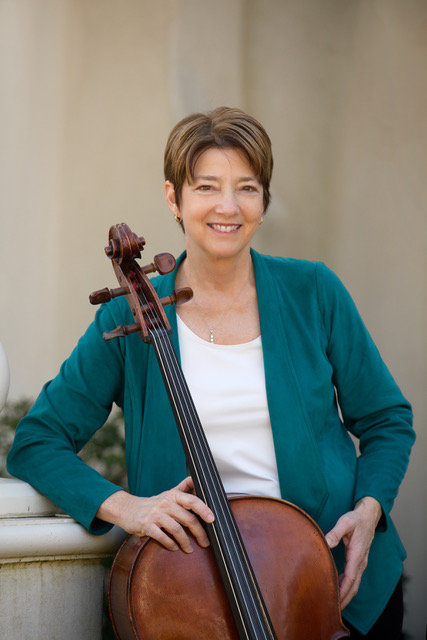
Susan Lamb Cook is currently Lecturer in Cello and Chamber Music at the University of California, Davis. She is a member of the Sacramento Philharmonic & Opera and the Sacramento Choral Society and Orchestra and is Artistic Director of the VITA Academy’s Great Composers Chamber Music Series. She is an active performer and educator both nationally and internationally and is sought after as soloist and chamber musician with performances throughout Europe, the Far East, and the United States. She has served on faculty for the Saarburg Festival, Germany, the Vianden Festival, Luxembourg, and on the artistic staff for the Classical Music Festival in Eisenstadt, Austria. As a member of the Kismarton Trio, Susan has performed concerts in the Hungarian National Museum and the Petöfi Museum of Literature, Budapest, and performed the opening concert for the 2024 International Music Festival, Grosslobming, Austria. She has performed as soloist with numerous orchestras and is highly regarded as master clinician. Following her studies at the University of Iowa with Charles Wendt, she moved to Vienna, Austria where she continued her studies and performed with numerous ensembles in Austria, Hungary, and Italy. During the decade she spent in Europe, Susan performed with the Arena di Verona opera orchestra, completing three seasons and joining the orchestra for a tour of Egypt with performances of Aida which used the grand Luxor Temple as backdrop. She completed at degree at the Academy of Music in Vienna, Austria under the guidance of Angelica May, then joined the teaching staff as assistant professor of cello, a position she held for two years before returning to her home of Sacramento.


