Showing posts with label Cello. Show all posts

Monday, May 19, 2025

Susan Lamb Cook in Conversation with Christian Baldini

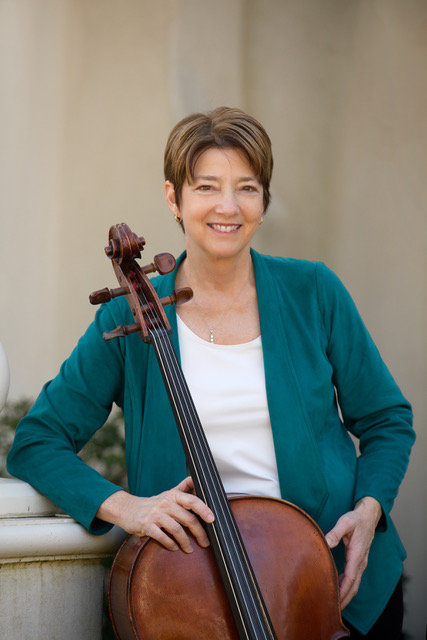
On June 7, 2025, I will have the pleasure of collaborating with cellist Susan Lamb Cook, once again, as our soloist. This time it will be Bruch's Kol Nidrei, with the Camellia Symphony Orchestra in Sacramento, in a program that also includes Mahler's Symphony No. 1 and the world première of Gabriel Bolaños' work "turbios". Below is a conversation with Susan:


Susan Lamb Cook is currently Lecturer in Cello and Chamber Music at the University of California, Davis.  She is a member of the Sacramento Philharmonic & Opera and the Sacramento Choral Society and Orchestra and is Artistic Director of the VITA Academy’s Great Composers Chamber Music Series.  She is an active performer and educator both nationally and internationally and is sought after as soloist and chamber musician with performances throughout Europe, the Far East, and the United States.  She has served on faculty for the Saarburg Festival, Germany, the Vianden Festival, Luxembourg, and on the artistic staff for the Classical Music Festival in Eisenstadt, Austria.  As a member of the Kismarton Trio, Susan has performed concerts in the Hungarian National Museum and the Petöfi Museum of Literature, Budapest, and performed the opening concert for the 2024 International Music Festival, Grosslobming, Austria. She has performed as soloist with numerous orchestras and is highly regarded as master clinician.  Following her studies at the University of Iowa with Charles Wendt, she moved to Vienna, Austria where she continued her studies and performed with numerous ensembles in Austria, Hungary, and Italy.  During the decade she spent in Europe, Susan performed with the Arena di Verona opera orchestra, completing three seasons and joining the orchestra for a tour of Egypt with performances of Aida which used the grand Luxor Temple as backdrop.  She completed at degree at the Academy of Music in Vienna, Austria under the guidance of Angelica May, then joined the teaching staff as assistant professor of cello, a position she held for two years before returning to her home of Sacramento.

Thursday, September 19, 2024

Daniel Godsil in Conversation with Christian Baldini

On September 28, I will have the pleasure of conducting Daniel Godsil's "Cathedral Grove" with the Camellia Symphony Orchestra in Sacramento. Also on the program are Brahms' Violin Concerto with Catherine Lin as our soloist and Shostakovich's Symphony No. 1. Below is an interview with composer Daniel Godsil. (click here for info about this program)

Christian Baldini: Daniel, welcome, and let's start by talking about your music. What was the genesis for Cathedral Grove? Is it different from your other music? What should people listen for in this piece?

Daniel Godsil: One of the things that really inspired this piece was a comment by composer Sam Nichols, my former teacher at UC Davis: he said that orchestral musicwith its relatively bigger scale, ​large performing forces, and sheer number of people working behind the scenesis really a public art. That really resonated with me, and got me thinking about other public spaces like our country's national and state parks. I often visited California's beautiful parks while I was studying at UC Davis, and decided to do an orchestral "sound-painting" of one of my favorites, Muir Woods (of which Cathedral Grove is a part). Around the time I was writing this piece, I was writing a lot of electronic music that used what I called "sound-shapes"...honestly kind of silly, but trying to render in sound very simple shapes like triangles, X-shapes or chiasms, circles, etc., as jumping-off points to start a composition. People can perhaps listen in this piece for big triangles and X-shapesroughly the giant shapes created​ by trees in the Muir Woodsrendered in sound. This piece was also a little different from my other work at the time in that I consciously tried to use more consonant combinations of notes. I often write using a spectrum of dissonant and consonant sound combinations, but for this work I experimented with trending more towards the consonant side of things. 

CB: Let's talk about your beginnings with music. How did it all start for you? Was there a particular "eureka" moment when you decided to become a professional musician?

DG: I started playing guitar at age 11. Throughout junior and high school I played mostly rock music, and (after learning just three or four chords) started forming bands with friends. I was writing tons of new songs and riffs all the time, which really the culture of rock music...everyone was writing their own stuff! I didn't think about it much at the time, but that environment was really teaching me the art of composition. My eureka moment was around the age of 17 when I really fell in love with film music. I realized that the orchestral timbres I was drawn to were difficult to achieve with the more limited pallet of tone-colors in rock, and found a piano teacher, learned how to read music, and more importantly, how to write it down and communicate with lots of other more classically-trained players. 

CB: Who are some of your favorite composers? Why? What do you look for in "new music"?

DG: This is a tricky question! It's often said that the music you learned to love in your adolescence is the music you love for your whole life, and that's definitely true for me. So that's a lot of heavy metal like Metallica, Megadeth, Slayer, Sepultura...and also film scoring in the classic Golden Age style like Erich Korngold, Max Steiner, John Williams, and James Horner. Because of my metal background I love "classical" music with lots of raw energy...Prokofiev, Shostakovich, Beethoven, and more recent composers like Georg Haas, Thomas Ades. And because of my love of film music I love composers who built a lot of drama into their forms...I love Sibelius! I also found myself very drawn to the American Symphonists of the 1930s and 40s who helped form the language that film composers use. Composers like David Diamond, Walter Piston, Roy Harris, and of course Copland. What I look for in new music, I think, really tends toward those two silly adolescent drives...energy and drama! 

CB: What's a day like for you? When is the best time to compose? Do you have hobbies? Do you exercise? How do you balance your life as a Professor with your time to compose and perform?

DG: I'm in my fourth year teaching music at Columbia College, in the foothills of the Sierra close to Yosemite. This job keeps me very busyit's a small school and I'm a department of one! I teach music theory, ear training, music history, private lessons, and I conduct the college orchestra. So I haven't found a lot of time to write much in the last few years while I figured out the job! I'm happy to report that I've (more or less) figured it out and am finding more time now to compose...mostly, for me, in the very early morning before my kids wake up. I'm a diehard hockey fan, and have recently gotten very much into astronomy/telescopes. I am an avid cyclist and exercise often...it's essential for me! It's the best medicine one can get. My job mostly (right now) calls on my performing abilities...I play a lot of piano and guitar (and have been studying jazz very in-depth recently) and have been conducting a lot. I find it very musically satisfying. ​

CB: What is your advice for your musicians who are starting out? How does one deal with frustrations? How does one stay positive?

DG: I always recommend that musicians should develop a very diverse and marketable skill-set...learn to compose! Play several instruments. Get good at video editing. Know how to record with a DAW and know what microphones work for what things. Maybe this doesn't work for everyone, but it does for me: if you get frustrated learning a Beethoven sonata or get composer's block, go learn a jazz standard for fun or go for a walk. 99% of the time that will help you forget your frustration and come back to whatever it was with a positive attitude. 

CB: Lastly, what is the meaning of music to you? I know this is a very big and general question. Feel free to answer it in any way that represents you!

DG: This changes for me a lot, but right now I'm just so grateful to be in a big community of great music makers, be it my students, the talented amateur players in my orchestra, or just friends who play bluegrass for fun. Especially now in this election cycle, there's a big push to look at life through a political lens...how much more fun and positive it is to apply a musical lens instead, and let that focus and inform everything else! 

CB: Thank you for your time Daniel, I look forward to making music with you!

DG: Thanks Christian! Can't wait to work with the wonderful Camellia Symphony! 

Daniel Godsil (Courtesy Photo)

Daniel Godsil's music, which has been described by the San Francisco Classical Voice as having an “intense dramatic narrative,” draws from such eclectic influences as science fiction, thrash metal, and Brutalist architecture. His more recent work draws inspiration from the natural beauty of Northern California, his current home.


Winner of the 2019 League of Composers/ISCM Steven R. Gerber prize (for Cosmographia) and the 2017 Earplay Donald Aird Composition Competition (for his quartet Aeropittura), Godsil's music has been played by Spektral Quartet, Ensemble Dal Niente, Talujon Percussion, Daedalus Quartet, Lydian String Quartet, Empyrean Ensemble, Metropolitan Orchestra of Saint Louis, UC Davis Symphony Orchestra, University Symphony Orchestra at California State University Fullerton, Knox-Galesburg Symphony, Secret String Quartet, and the Nova Singers, among many others. Recent film scores include the PBS documentary Boxcar People, Man Ray’s 1926 silent film Emak-Bakia and the feature film H.G. Wells’ The First Men In The Moon. Godsil was a finalist in the 2018 Lake George Music Festival chamber composition competition, as well as the 2014 and 2019 Red Note New Music Festival Composition Competitions. His choral works are published by Alliance Music Publishing and NoteNova Publishing, and his chamber and orchestral music is published by BabelScores in Paris.

Born and raised in central Illinois, Godsil (b.1982) holds his PhD. in Composition and Theory from the University of California, Davis, where he studied with Pablo Ortiz, Mika Pelo, Laurie San Martin, and Sam Nichols. He holds an MFA in Music Composition from the Vermont College of Fine Arts, where he studied with John Fitz Rogers, John Mallia, and Jonathan Bailey Holland. He also holds a BM in Music Composition from Webster University.

Godsil was selected to participate in the 2017 Summer Institute for Contemporary Performance Practice (SICPP) in Boston, where he had master classes with composers Nicholas Vines and Georg Friedrich Haas.

Godsil has also been active as an educator, conductor, and performer in the central Illinois area, Knox College, Monmouth College, and Carl Sandburg College. At Knox College, he directed the New Music Ensemble, Wind Ensemble, Chamber Ensemble, and Men’s Chorus. He has also held posts as choral accompanist and collaborative pianist, and served as Music Director and Organist at Grace Episcopal Church in Galesburg, IL.  

Godsil is a professor of music at Columbia College in Sonora, California. He has also served as artistic committee president for Ninth Planet New Music, a trailblazing new music ensemble based in California's SF Bay Area. 


Wednesday, February 7, 2024

Dagenais Smiley and Susan Lamb Cook in Conversation with Christian Baldini


On February 17, 2024, I will have the pleasure of collaborating with violinist Dagenais Smiley and cellist Susan Lamb Cook bringing to life together the beautiful Concerto for Violin, Cello and Orchestra by Brahms. This will be in Sacramento with the Camellia Symphony Orchestra. After intermission, we will perform  Bruckner’s 5th Symphony. Here is a conversation we had with Susan and Dagenais, in preparation for our performance.


Christian Baldini: Welcome, Susan and Dagenais, it will be a real treat to do this double concerto with you. Please tell me, what are some of your favorite features about this piece? Why is this such an important piece in the repertoire, and what do you love about it?


Susan Lamb Cook:  I have always been a fan of the music of Brahms and have studied and performed much of his chamber music repertoire, from the wonderful cello sonatas, to his string quartets, quintets, sextets, piano trios, quartets – the list goes on.  So, having the opportunity to perform the Double Concerto is truly a highlight for me, especially with my dear friend and colleague Dagenais Smiley as well as with you, Christian, and the Camellia Symphony Orchestra.  So often, concertos begin with a long orchestral introduction but in this case, Brahms launches immediately into a cello cadenza, similar to the opening of the Elgar Concerto which I had the pleasure of performing with you and the CSO last season.  In Brahms’ opening cadenza, he soon has the violin join in, creating a conversation between the two instruments which gives a preview of what is yet to come.  The Brahms Double is an expansive work containing technical and musical challenges not only for the soloists but for the orchestra as well.  This was Brahms’ final symphonic composition, and one can hear the luscious textures which Brahms is so famous for throughout this monumental work.


Dagenais Smiley: As a violinist, I always love playing the works of Brahms, from the symphonies to the string quartets, and his violin concerto is one of my favorites. He always writes incredible melodies, and intense textures, which is thrilling to perform.  I haven’t had the pleasure of working on the Double Concerto before now and it’s been an incredibly rewarding undertaking.  It’s a unique experience to share a concerto with another instrument, especially the rich voice of the cello, and as Susan already mentioned, it’s like having a conversation with a colleague.  It is technically demanding while still presenting beautiful, soaring melodies.  It’s interesting to note  that it wasn’t immediately a hit upon its presentation, but it has now become a favorite amongst both cellists and violinists.  I am extremely excited to be performing this work with Susan and with you, Christian, and the Camellia Symphony!


Christian: As you know, composers (and especially followers in their circles) had rivalries, and this was also the case between Brahms and Bruckner. Constantin Floros states that “In the last third of the 19th century Brahms and Bruckner were regarded as antipodes.” For different reasons, this was also the case at times with performers. Brahms and the famous violinist Joachim (for whom the Double Concerto was written, together with cellist Hausman) had had a fallout. Brahms offered this concerto as an olive branch to Joachim. In fact Clara Schumann wrote in her diary that after Joachim, Hausmann, and Brahms had tried out the piece for friends, “The Concerto is a work of reconciliation. Joachim and Brahms have spoken to one another again.” - My long related questions to both of you are: What does music mean to you? Is it possible to alter/affect the human spirit through music? Which kind of atmosphere does it communicate, or which kind of spirit inhabits this particular concerto?


Susan:  The world of music, and specifically the cello, has been a part of my life ever since I can remember, so I feel as though the cello is simply an extension of who I am.  My cello and I spend so much time together – in the practice room, in the teaching studio, on the concert stage – that I really can’t imagine my life not being filled with music and the art of music making.  As to whether or not music can possibly affect the human spirit, my answer would be absolutely, yes.  It is interesting how we each seem to be drawn to different styles or genres of music, composers, artists etc., and sometimes we can all listen to the same piece of music but each has a completely different reaction to it.  Our reactions can include joy, excitement, sadness, despair, but the fact is that we react or respond to the way in which the music touches us emotionally.  I do hope that, through our performance of the Brahms Double, we will be able to stimulate reactions from the audience members, perhaps a feeling of excitement from the powerful opening statements of both the first and last movements, as well as a sense of affection and joy from the gloriously optimistic melody of the second movement.  This monumental work leaves me breathless, so I hope it will do the same for our audience members.


Dagenais:  My relationship with my violin and with music is much like a relationship/friendship with a fellow person.  Sometimes it’s filled with joy and humor, sometimes sadness and even a bit of frustration, but it’s always there and as Susan has already stated, I can’t imagine a life without playing music. I had the opportunity to play Mahler 4 recently and during some of the rests, I looked out into the audience and saw how rapt the audience was, and some attendees were even in tears, so yes, I do believe that music has the ability to affect our spirit.  I have favorite pieces I gravitate towards when I’m in a certain mood, as I’m sure we all do, and part of why I love performing (any type of music), is the connection with the audience.  It’s very rewarding to bring the joy, beauty, emotion, sadness, etc. of music to new people.  I’ve talked to some who have never attended a concert before and they were so excited and moved by what the music made them feel.  I look forward to sharing this great piece with the audience and I also look forward to hearing the Bruckner!

Christian: You are both wonderful educators, and colleagues of mine at the University of California, Davis. What are some of your favorite things about working with young people and helping them grow as musicians and human beings?

Susan:  Teaching brings me great joy - I really love working with my UC Davis students as well as my adult and my pre-college students.  Many of my students at UC Davis have chosen fields of study other than music, like animal sciences, engineering, environmental science, etc., but they truly love and value their connection to music through their cello. I am pleased and honored to assist them in becoming better players so that they will have the life-long ability to continue expressing their passion for music through their cello playing.  I continue working with pre-college students through my Rising Stars of Chamber Music Program which takes place each year over the winter holiday.  The students in this program are advanced players who are passionate about chamber music and are totally committed to their music making,  As these students study some of the great works in the chamber music repertoire, I can see them develop as musicians through their understanding of musical lines and phrases, and more importantly, I can see them develop and use tools of cooperation and collaboration while working with their group members, which ultimately allows for wonderful friendships to be formed.  This is one of the greatest benefits of being a musician. 


Dagenais: As Susan mentioned, many of the students we have are majoring in other challenging disciplines yet they want to maintain that connection to music and their instruments.I help them with time management and give them suggestions on how to practice efficiently with limited time and I love seeing the excitement in my students’ eyes when they realize how much progress they’ve made over the quarter.  I am very proud of my students when they are able to master a new technique or play a piece they never thought they would be able to before through their hard work and diligence.  It’s rewarding seeing how important music is to them despite how busy they are in their other fields and I am grateful to have the opportunity to work with them on their musical journey.

Christian: Lastly, what would be your advice for young musicians? We have all felt challenges in life. Most people have thought about quitting, multiple times in many cases. What advice would you give to someone who is struggling with their musical development?

Susan:  There is no doubt that succeeding in music takes a great deal of time, effort, and commitment, and I can certainly remember that, when I was younger, there were periods of time in which I simply wanted to give up.  I was fortunate, though, to have had wonderful teachers along the way, not to mention my parents who were always encouraging me to continue practicing and not be discouraged if things did not always go as I had hoped (in performances, competitions, etc.).  As musicians, we are always putting ourselves on the line, baring our souls to the listener and opening up an often intimate and very personal part of ourselves. Not an easy thing to do.  I always tell my students, though, that every performance is a dress rehearsal for the next performance, with the thought that we are always practicing, doing our best to improve and, of course, always striving for the perfection that we may never achieve.  Some great advice that I received early on was to surround myself with those who were better than me so that I could always continue learning.  This advice has served me well, not only in the area of music. 


Dagenais:  My approach to teaching is to be encouraging, but also realistic and understanding.  One of my students was struggling with the motivation to practice,  so we had a chat about it and I acknowledged that student’s feelings (we’ve all been through that struggle in our life) and gave them some advice on how to move forward. I think it’s important to recognize when something is a struggle and to accept and acknowledge those feelings rather than try to erase them. I try to teach my students to have patience with themselves (something that I struggled with in school). It’s ok to take a day off practice when you’re in a negative head space and return the next day feeling refreshed and excited to begin again. It’s easy to get stuck in the cycle of trying to achieve perfection and the rat race of gigging so much that we can sometimes get frustrated and lose the joy of performing. It’s important to take the time to remember what music means to us. Sometimes it can be a wonderful change to attend a concert rather than performing in one to remember how powerful it can be to experience live music.

Christian: Thank you both very much for your time, and especially for your wonderful musicianship that I will be delighted to share with our audience in Sacramento!


Dagenais Smiley, a Northern California native, earned  her bachelor’s degree from the Oberlin Conservatory  under the direction of Milan Vitek and her masterof music from the USC’s  Thornton School of Music, studying with Ms. Kathleen Winkler. An active orchestral and chamber musician, Dagenais performs with the Sacramento Philharmonic and Opera, and is currently acting Associate Concertmaster with the Modesto Symphony, often stepping in as Concertmaster. She recently became Assistant Concertmaster of the Reno Philharmonic and also performs with the Stockton Symphony, the Monterey Symphony, the Fresno Philharmonic, and other various Northern California  orchestras. Ms. Smiley currently teaches violin at UC Davis and maintains a private violin studio. She enjoys skiing, hiking and playing Pokemon Go in her spare time.


Saturday, September 17, 2022

Susan Lamb Cook in Conversation with Christian Baldini

 
On September 24, 2022, I will have the pleasure of conducting the Elgar Cello Concerto with Susan Lamb Cook and the Camellia Symphony Orchestra in Sacramento. I had the chance of asking Susan some questions about our program, and below are her answers:

Christian Baldini: Dear Susan, it will be a pleasure to collaborate with you once more as our soloist, this time with the beautiful Elgar Concerto. Can you tell me your history with this piece? When did you first come across it, and what are some of your fondest memories of playing it?
 

Susan Lamb Cook: I was first introduced to this piece when I was just finishing my studies at the University of Iowa.  After a friend shared with me the famous recording by Jacqueline Du Pré, I was so moved by this music that I felt I simply had to learn it.  It was not as easy to acquire sheet music at that time as it is today, so I had to wait some time before I could get started and, besides, I was in the process of moving to Europe to continue my studies and it took some time to get settled back into a serious practice routine.  Although I spent a great deal of time working intensively on this piece, it wasn’t until almost 10 years later that I had the first opportunity to perform it with orchestra, and that was in fact with Dan Kingman and the Camellia Symphony in 1989.  I had just returned to Sacramento from Europe and was thrilled to be able to perform this piece so dear to my heart back in my hometown with such fine local musicians.  A few years later, I was contacted by a colleague whom I had met in Vienna, and who was at that time the music director of the Cairo Symphony in Egypt.  Interestingly, I had already been to Egypt twice, once as a tourist and again as a member of the Ente Lirico Orchestra from Verona, performing Aida at the Luxor Temple. Obviously, I jumped at the chance to return to Egypt, especially to perform the Elgar Concerto with the Cairo Symphony and guest conductor Antoine Mitchell at the Cairo Opera House.  Many years later, I had the joy of performing the Elgar with the UC Davis Symphony in beautiful Jackson Hall at the Modavi Center, and now I have returned full circle to the Camellia Symphony!   

 
CB: Besides being a remarkable musician yourself, you are also a phenomenal cello teacher. What do you try to instill in your students' minds? What are some of the most important teachings that you hope they take away from you?
 
SLC: In our current environment in which everything seems to be moving at lightning-speed around us, it is hard not to expect that a skill like learning a musical instrument should come quickly and without much effort. However, for anyone who has stepped into this world of music, it becomes immediately apparent that patience, method, practice and above all time, are the essential ingredients for success.  Obviously, the physical aspect of learning an instrument is only one part of the equation.  Being fluent in music theory is important to understanding the relationships between notes and their function in the structure of the piece.  In addition to studying music theory, I encourage my students to learn as much as they can about the composers, their lives, and the history of the times in which they lived.  All of these ingredients add to a fuller and deeper understanding of the music we are hoping to interpret through our own voice and personal expression.    
 
CB: You are also very active performing chamber music with your wonderful colleagues. What are some of the pieces you would still like to perform, which you have not had a chance to yet?
 
SLC: When I founded the Great Composers Chamber Music Series in 2014, the programming was planned through the lens of a western European eye.  Because of my experience in Vienna, my comfort zone had always seemed to be within the realm of the European classical and romantic periods, so I therefore started off with a complete Beethoven series, followed by a complete Brahms series.  Obviously, each of these composers has a plethora of chamber music works to choose from, so it was not difficult to fill out each of those series.  Each year, I continued programming works which I considered to be by the “Great Composers”, mostly European men, however, it was only in more recent years that I realized how narrow my focus really was.  I am so thankful to colleagues who have encouraged me to open my eyes to lesser-known composers and their works that deserve to be programmed alongside what we might consider the “standard” repertoire.  It has been a fascinating and humbling journey as I discover, for the first time, wonderful chamber music works by women and composers of color whose works have been neglected over time, and I hope that the Great Composers Chamber Music Series will move forward as a platform embracing all great composers.
      
 
CB: What would be your advice for any young musician trying to make it in the profession? Any advice about auditioning for orchestras, being constant, and not losing hope when we (inevitably) fail during some auditions?
 
 
SLC: As I mentioned earlier, patience, method, practice, and time are essential ingredients to learning an instrument, but here I will also add the importance of working with excellent teachers, listening to others and, if one wants to go into the profession, getting performance experience, particularly through public recitals and competitions.  It is one thing to sit in one’s home environment practicing a piece, and a completely different experience when performing that piece in a competitive setting or in front of an audience.  Each one of us deals with the stress of performance in a different way, and the earlier one can figure out how to handle this very personal issue, the better.  Fortunately, the world of music offers many opportunities to those who want to make it their profession, so I believe that the more well-rounded one can be, the more likely one can create a sustainable life in music.  Many orchestral musicians also perform as chamber musicians, have active teaching studios, and participate in school or community presentations in order to create a sustainable income.  I think that it is important for students to understand that sitting and playing an instrument is only one thread of the fabric that will make up their life as a musician, but such a life is enriching beyond measure.


Susan Lamb Cook is Lecturer in cello and chamber music at the University of California, Davis, a member of the Sacramento Philharmonic & Opera and the Sacramento Choral Society and Orchestra, and director of the VITA Academy’s Great Composers Chamber Music Series at the Harris Center in Folsom. Her solo performances include those with the Sacramento Philharmonic, the UC Davis Symphony Orchestra, the Reno Philharmonic, the Cairo Symphony (Egypt), the Paradise Symphony, the Camellia Symphony, and was featured as soloist in a Gala Concert in the Esterhazy Palace, Eisenstadt, Austria with the Classical Music Festival Orchestra. As an active performer and educator both nationally and internationally, Susan has completed five concert and teaching tours of China, has performed and given master classes at San Francisco State University, Scripps College, Harvey Mudd College, Marshall University in West Virginia, Austin College in Texas, and Dixie State University, Utah, and her performances have been featured on National Public Radio and Austrian National Television. She has served on faculty at the Saarburg International Music Festival in Germany, the Vianden Festival, Luxembourg, and on the artistic staff for the Classical Music Festival in Eisenstadt, Austria, and has performed at the Hungarian National Museum in Budapest.  Susan performs regularly for the UCD Shinkoskey Noon Concert Series, the Westminster Music At Noon Series, and the Crocker Art Museum’s Classical Concert Series.

As Director Emeritus of the Sacramento Youth Symphony’s Summer Chamber Music Workshop, Susan spent 30 years developing this program which trains youth musicians in the art of chamber music and, in 2019, the Sacramento City Council awarded Susan a Resolution recognizing her work with young, local musicians.  In July 2020, Susan developed Sacramento Summer Music, an educational program for young chamber musicians which focused on under-represented composers including women composers and composers of the African Diaspora. This program ultimately developed into the Sacramento Summer Music Virtual Festival of Concerts, and “Concerts and Conversations” produced by the Great Composers Chamber Music Series in collaboration with the Sacramento Baroque Soloists and the Sacramento Guitar Society, all partner organizations of the Harris Center. Susan is a member of the Chevalier String Quartet and, in collaboration with clarinetist Deborah Pittman, created a multimedia project centered on the life of Joseph Bologne, Chevalier de Saint-Georges called the “Chevalier Project” which includes a film, study guide, and musical examples of the works of Saint-Georges.

Susan’s past performances can be found on YouTube at Susan Lamb CookConcerts and Conversations, and the UC Davis Music channel.


Tuesday, February 15, 2022

Amos Yang in Conversation with Christian Baldini

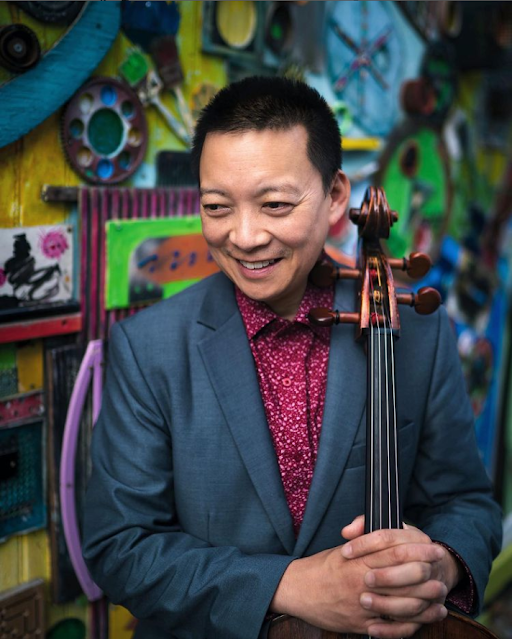
Christian Baldini: On February 19 I will have the pleasure of welcoming one of the most outstanding cellists in the US to play Prokofiev's Symphony Concerto Op. 125 as our soloist with the Camellia Symphony Orchestra in Sacramento. Amos is the assistant principal cello with the San Francisco Symphony, and has had a long and extremely successful career collaborating with some of the most important musicians of our time. Amos, can you start by sharing with us why this piece by Prokofiev is so important to you? And why do you think it is so rarely performed?


Amos Yang: It’s a tour de force for everyone on stage which I think makes it so much fun. The challenge for the orchestra is to balance the fine line between chamber music and full symphonic tuttis. For me, the scope of it is something I’ve always been in awe of and is a bit like Alex Harold climbing El Capitan free solo. The sheer forces and complexity of the piece are challenging but more and more people are playing this piece as our collective technique improves.

CB: Please tell us about your background. Do you come from a musical household? How did you get started with music? When did you decide/realize you would make this commitment of becoming a professional musician?


AY: My parents aren’t musicians but they LOVE music and wanted to share that love with all of their children. I started at the SF Conservatory of Music under the tutelage of Irene Sharp. She was an amazing teacher and dedicated to all of us reaching our full potential. It wasn’t until my junior/senior year in high school though that I made the decision to make a go of it as a musician.

CB: As a cellist, chamber musician and member of one of the greatest orchestras in the world, what/who would you say have been the most inspiring experiences in your life?

 
AY: My colleagues inspire me daily with the level of playing they achieve. Touring the world with the orchestra is inspiring in and of itself. I love playing in different concert halls in different cities. It gives you perspective when you return home and while tours are brief, you get a feel for many new places and people.

CB: Who have been your most important mentors, and why?


AY: As a cellist Irene Sharp helped mold me from the age of 5. I became a cellistic mutt after that and owe a great deal to all my professors. Channing Robbins, Joyce Robbins, Paul Katz, Steve Doane and Joel Krosnick to name a few. Channing helped organize me, Joyce guided me as only a violinist could, Paul helped me greatly with sound, Steve inspired with his playing and Joel showed me what a true understanding of musical intent can convey.

CB: Why would you say performing music is important? What does it bring or add to our everyday lives? What is its role in society?


AY: It is a cliche but music really is a language without borders. It can bridge racial, cultural, social and monetary differences. Unlike languages that are usually organized with borders, music flows easily without these limitations. Because there aren’t words in much of music, the same music means something different to all who hear it. Yet, we perceive harmonies and melodies in a similar uniquely human way.

CB: What would be your advice for young musicians? What was helpful to you? How do they stay motivated, on track, and always in a growth mindset?


AY: For all young musicians I’d advise you to learn how to sing. Singing a phrase is by far the easiest and most natural way to figure out how you should shape an idea of music. Motivation is different from person to person. If you are like me, it helps to have a carrot for motivation. For me that meant competitions, auditions etc…For others that might be scheduling performances as goals.  It’s hard to stay motivated if one doesn’t have an audience to play for and share our music with.

CB: Lastly: what are three or four things that people should listen for in the Prokofiev Symphony Concerto? What would you say to someone who has never listened to a work by Prokofiev?


AY: Enjoy the banter between the soloist and the orchestra. Listen for dialogue as you might in a movie.

CB: Thank you very much for your time Amos. I very much look forward to our performance on February 19!


AY: Thank you I’m looking forward to it as well!


Watching San Francisco Symphony Assistant Principal Cello Amos Yang onstage, you’d never guess that his introduction to the cello was anything less than love at first sight. “My mother and I were going to sign up for violin lessons when we bumped into a family friend whose daughter had just auditioned for a wonderful new cello teacher,” he says. “My mom asked me if I wanted to try the cello, I shrugged my shoulders indifferently and off we went to the audition. It turns out the audition consisted of ‘bear hugging’ a tiny cello. As soon as I did that I was accepted into the studio and here I am forty plus years later still playing and hugging my cello most mornings.”

Amos’s is a uniquely San Francisco story. He studied with Irene Sharp at the San Francisco Conservatory and played with the SFS Youth Orchestra in its early days. “I was a bit of a challenge as an easily distracted eleven-year-old, but I'm glad they stuck with me. It was a terrific experience and training ground.” Amos’s studies weren’t limited to orchestral playing, however. “The San Francisco Boys Chorus also helped develop my physical and musical voice. I am constantly encouraging my students to sing and most of them are too embarrassed and inhibited to do this. If you can sing it you can play it!”

He went on to earn degrees from the Juilliard School before landing a post with the Seattle Symphony and performing as a member of the Maia String Quartet. Winning a position with the SFS in 2006 offered a rare and prized opportunity to join his hometown orchestra.

Amos’s return to the Bay Area continued the circle in more than one way. His son, Noah, also studies cello with Irene Sharp, while Amos teaches at the San Francisco Conservatory. He and his wife, violinist Alicia, are also parents to a daughter, Isabel, a budding violinist who sings in the San Francisco Girls Chorus.

The enormity of being part of the orchestra he listened to as a child isn’t lost on Amos. “Anytime we set foot in or draw the bow across the strings in a place like the Concertgebouw or the Musikverein, it's like a baseball player playing a game in Yankee Stadium or for a basketball player, the Boston Garden. It's a blessing and a privilege to share music with audiences in these settings.”

Thursday, February 21, 2019

Soloist Profile: Joy Yanai in Conversation with Christian Baldini

In preparation for our upcoming concert in Sacramento with the Camellia Symphony Orchestra, I had the pleasure of interviewing Joy Yanai, who will be our soloist for Dvorak's Silent Woods and Saint-Saëns' Cello Concerto No. 1. 

 
Christian Baldini: Joy, it is a real pleasure to have you with us as our featured "Rising Star" soloist for this concert. I am very grateful to Eunghee Cho (Artistic Director of the Mellon Music Festival) for making me aware of your talent! How did you meet Eunghee?


Joy Yanai: It is such a pleasure for me to join the orchestra as well! Eunghee and I were both in the studio of professor Paul Katz at New England Conservatory of Music in Boston, MA. Eunghee is not only an excellent cellist, but also a fantastic producer who is always willing to share his ideas and passion with other musicians and audiences. I really appreciate the many wonderful musical experiences Eunghee has given me including the opportunity to perform on his Mellon Music Festival which led to this Rising Star Concert.

CB: For our concert you will be performing three very different pieces. The Suite for Cello Solo by Gaspar Cassadó, and then with the orchestra, Dvorak's Silent Woods and Saint-Saëns' Cello Concerto No. 1. Can you tell me how you feel about the program and specifically about each of these pieces? What is special to you about them?

JY: Saint-Saëns' first Cello Concerto is oftentimes stuck with a bad rep as a "student concerto" because it is one of those pieces that pre-college students will learn to show off their technique. I am ashamed to admit that I was also one of those young cellists who reveled in the virtuosic scales and tricky arppegiations of the concerto. Returning to this concerto after many years, I found that the music is full of so many different colors and so much more emotional richness than I remembered. There is actually no specific reason for programming these pieces, but I tried to pick pieces that it would be interesting and fun to listen if I were in the audience. To be completely honest, many of Dvorak's works do not attract me in particular, I am convinced that his Silent Woods is one of the most beautiful pieces ever written for the cello. Every time I perform this piece, I feel as if I am telling a fairytale that simultaneously caresses and arouses the heart. Cassadó's Suite for Cello Solo is one of the my favorite pieces because it immediately sends me to Spain- a place where I still have not visited. It also always amazes me how versatile the cello itself can be with Cassadó's imaginative extended techniques. I would be very happy if I can share my feelings with the audience at the concert! 

CB: Tell us about your background. Where did you grow up? When did you start learning music and the cello? Was there someone who was particularly important in your upbringing, who was an inspiration to you and helped you become a musician?

JY: I was born in Montreal, Canada and raised in Sendai, Japan. I learned the piano first, but I never liked it because there were too many notes to deal with. I started leaning the cello when I was five years old because my mother really loves cello. I still clearly remember when my parents gave me my first cello as a Christmas Present. Though there are many people who supported and helped me become a musician, meeting professor Laurence Lesser was the turning point of my life; without him, I probably never would have considered studying outside of Japan. We met at the Orford Music Academy, my first ever international summer festival, when I was 12. I did not speak any English at that time, but Mr. Lesser was very patient with me in each lesson. When I came to the states for the first time for high school, he became my private teacher for the following 8 years.  

CB: What are some of the most memorable experiences of your childhood? 

JY: Some of the most memorable experiences of my childhood are playing in snow with my yellow lab in the winter and catching butterflies and dragonflies in the summer on a hill just behind my house in Japan. There were not many children around my age in my neighborhood at that time, but I never felt lonely because I was completely enamored by nature. My name is spelled Joinatsuru in Japan, but it is spelled "Naturu Joy" in Canada where I was born. My father named me "Naturu" after the great nature that is so special in Canada. It seems that in my case, my name truly does reflect my nature (excuse the pun!).

CB: You have obviously accomplished a lot already, playing chamber music, as a soloist, and developing your own voice. And where would you like to be in 5 or 10 years? What would you like to be doing, or where?

JY: My dream job is playing year-round in a professional opera orchestra. 

CB: Which other activities do you enjoy, outside music?

JY: When I am in the states, I would have to say that cooking is my favorite and most dedicated hobby. However, when I am in Japan, my absolute favorite activity is visiting Japan's many hot springs. 

CB: What would you recommend to a young musician starting out? What is some good advice for someone who would like to become a professional musician?

JY: Whenever you feel like you have explored all the great music in the world, keep searching for more. There is so much to experience as a musician outside of the confines of the practice room. All of this experience contributes to who we are a as a musician and expanding your horizons into other genres and performance mediums will only serve to nurture your connection to music. Also, practicing should never feel like a chore. Even though it is undeniable how much we enjoy playing our instruments so much, sometimes we need a break from practicing. Go ahead and take that break!

CB: It's been really wonderful to have the chance to know more about you and your upbringing. Thank you for sharing your wonderful talent and dedication with your audience, and I very much look forward to our performance together!

JY: Thank you for giving me such a wonderful opportunity to play with you and your orchestra and also to talk about myself. I am very excited to meet everyone in the orchestra and in the community! 


BIOGRAPHY
Canadian-Japanese cellist Joy Yanai began taking cello lessons at the age of five in Japan before attending Walnut Hill School for the Arts in Natick, MA under the tutelage of distinguished pedagogue Laurence Lesser. She continued her studies in Boston at the New England Conservatory of Music completed B.M. and M.M. degrees, as well as a Graduate Diploma studying with Paul Katz and Lluís Claret.

In 2011 she actively joined the Earthquake and Tsunami relief efforts for Japan both with solo recitals in the affected regions and with fundraising performances in collaboration with Kim Kashkashian, Paul Biss, Laurence Lesser, and Masuko Ushioda. She participated in such international music festivals as Pacific Music Festival, Seiji Ozawa Music Academy Opera Project and Ozawa International Chamber Music Academy.

She actively performs with A Far Cry, Boston Philharmonic Orchestra, Atlantic Symphony Orchestra, Phoenix Orchestra, and Eureka Ensemble. She will be performing as a Festival Artist at the Mellon Music Festival in Davis, CA in May 2019.