Thursday, October 28, 2021

Alina Kobialka in Conversation with Christian Baldini

On November 6th, 2021 I will have the pleasure of conducting the Camellia Symphony Orchestra in the rarely performed Violin Concerto by Carl Nielsen with a wonderful soloist that I've known for many years, and with whom I've collaborated several times. Alina Kobialka comes from a distinguished musicians' family, in fact both of her parents were (her mother still is) key members of the San Francisco Symphony, an orchestra with which Alina made her solo debut at age 14, for their 100th anniversary. 

Christian Baldini: Dear Alina, it will be such a treat to collaborate with you once again. I remember fondly our previous performances with you as our soloist, whether it was the Sibelius, the Beethoven, or the Waxman Fantasy, you always bring so much to the table, so much commitment and talent, and it is always very beautiful to work with you. Tell me, how are you feeling about this upcoming concert, and what can you share with people about the Nielsen Violin Concerto? What makes it so special, and why do you think it is so rarely performed?

Alina Kobialka: I am incredibly excited for this upcoming concert and the opportunity to play with you and the Camellia Symphony again, especially with such a special concerto! I have the best memories of collaborating with you, and all those performances we did together really helped me grow and develop into the musician I am today.


The Nielsen concerto has two movements, with both consisting of a slower beginning leading into a faster section. In addition, he was quite particular about the concerto being virtuosic and dazzling without turning superficial. This turned out to be a challenge that he struggled with for quite some time, but I believe he ultimately succeeded in fulfilling his goal. 


Although the concerto is greatly loved by many musicians, it is rarely performed, as you mentioned. I believe a reason for this is because Nielsen’s music takes time to digest with all its harmonic twists and turns. A passage can seem to be going one way but then he writes something that goes a completely unexpected way. Part of the fun of his music is the more you listen to it, the more you discover. This takes time but is extremely rewarding. 


CB: You come from a very musical household, so this question might be pretty straightforward to you. As a violinist, what/who would you say have been the most inspiring experiences in your life? When did you decide/realize you would make this commitment of becoming a professional violinist? 


AK: I am very grateful to my teacher Ilya Kaler for being an inspiring and influential figure in my musical growth, as well as my former teachers Robert Lipsett, Danielle Belen, Wei He, and Li Lin.


In terms of inspiring musical experiences, I would say joining the San Francisco Symphony Youth Orchestra really fostered my love for classical music and ultimately led to me deciding to become a professional musician. It was so special for me to play great music with wonderful and inspiring peers every Saturday. We were also so lucky to be coached by San Francisco Symphony musicians and meet incredible guest artists that would be in town playing with the SFS. Even a decade later, I often fondly reminisce that special time in my life. 


CB: Can you recall two or three examples of people that you've loved working with, and why?


AK: First and foremost, I had such an incredible time working with conductor Michael Tilson Thomas. His support and guidance were so inspirational, and I often find myself thinking of his advice during my practice sessions. 


During my time at the Marlboro Music Festival, I had the immense honor of working with pianist Mitsuko Uchida. I looked so forward to every rehearsal, as she would have fun anecdotes and was such a sincere and joyful person to work with. She truly puts the music first and foremost, and I find that so inspirational. 


Finally, I had an amazing time working with violinist Vadim Gluzman. Not only is he a fantastic musician, but he is also immensely kind and quite hilarious! We performed a double concerto together, and I felt that he really brought out the best in my playing. Working with these three incredible artists has been so influential for my musical growth and development. 


CB: Why would you say performing music is important? What does it bring or add to our everyday lives?


AK: Music is such a wonderful and essential form of expression. We encounter it all the time, whether it be at concerts, in movies, or even in the elevator. It can touch people in wonderful and mysterious ways, and it adds so much value and color to our everyday lives. For myself, I find it immensely therapeutic and grounding to take my violin out of my case and play, rain or shine. 


CB: What would be your advice for young musicians? What was helpful to you? How do they stay motivated, on track, and always in a growth mindset?


AK: I would say to be critical but also remember that we are only human. Self-compassion is an important skill to have, both with music and life in general. Mistakes are inevitable, and sometimes they will be the most valuable experiences we draw on. 


I would also say play for and collaborate with other musicians when possible, attend concerts and masterclasses, and most importantly, enjoy the ride. Even if this doesn’t end up being your profession, learning music can really change a person’s life for the better.


CB: Lastly: what are three or four things that people should listen for in the Nielsen Violin Concerto? What would you say to someone who has never listened to a work by Nielsen?


AK: In the Nielsen concerto, be ready for some fun harmonic twists and turns! In addition, he wrote this with a Neoclassical melodic structure, so see if there are any melodic lines that you can grab onto and listen for in future sections. For someone who has never listened to a work by Nielsen, I would say the elements I mentioned above also apply. Many of his works contain unusual tonal structures, and it is always quite an interesting journey for both the listener and performer. 


CB: Thank you very much for your time Alina. I very much look forward to our performance on November 6!


AK: Thank you so much, Christian! I can’t wait!
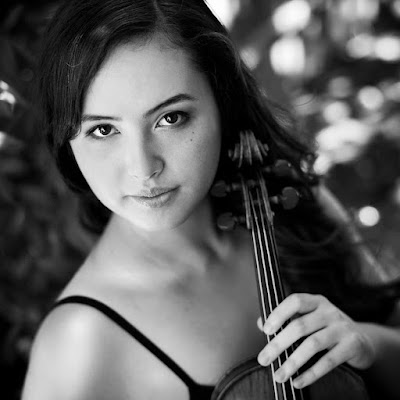


Alina Kobialka (courtesy photo)


Alina Kobialka has been praised as a remarkable violinist due to her beautiful
tone, effortless precision, and musical maturity beyond her years. After her first guest
solo appearance with orchestra at the age of ten, she has toured and performed with many
ensembles throughout the world. The San Francisco Classical Voice described her as a
“jaw-droppingly assured” soloist, who “made present and future converge.” The Las
Vegas Review Journal wrote, “Watch for her name. She appears to be bound for
greatness.”

Alina began her studies at the age of five with Li Lin. She continued on to the
San Francisco Conservatory Preparatory Program, where she studied with Wei He.
Leaving San Francisco at age 16, she attended the Colburn Music Academy in Los
Angeles, where she studied with Robert Lipsett and Danielle Belen. Most recently, Alina
graduated from the Cleveland Institute of Music with her Master’s in Violin
Performance, under the tutelage of Ilya Kaler.

At age 14, Miss Kobialka made her solo debut with the San Francisco Symphony
at their 100th Anniversary Reunion Concert in Davies Symphony Hall, where she has
since returned three times as a soloist. Soon after, she was featured live on the nationally
acclaimed radio show NPR’s From the Top. Since then, Alina has performed with
various American orchestras, including the Las Vegas Philharmonic, ProMusica
Chamber Orchestra, California Symphony, the Colburn Academy Virtuosi Orchestra, and
others.

In 2015, Miss Kobialka made her performance debut in Asia with the Macau
Youth Symphony for their New Years’ Concert. She returned in 2016 to tour Japan with
the Kagawa International Youth Orchestra, and in 2017 to perform in the Shanghai
International Arts Festival gala concert.

Alina was awarded second prize as the youngest competitor of the 2017 Elmar
Oliveira International Violin Competition. Other competition accolades include being a
laureate of the 2016 Irving M. Klein International Competition and receiving the Grand
Prize at the Mondavi Center National Young Artists Competition.

Recent concert highlights include performing with world-renowned conductor
Michael Tilson Thomas and the San Francisco Symphony and making her debut with
Vadim Gluzman and the ProMusica Chamber Orchestra. She also performed a guest
artist recital at Southwestern University in Texas and Brahms Double Concerto for Violin
and Cello with the California Symphony.

An avid chamber musician, Alina has been an artist at the Marlboro Music
Festival for the last few years. This past summer, she had the great honor of performing
with acclaimed pianist Mitsuko Uchida. Other celebrated musicians she has worked with
include pianist Jonathan Biss, violist Kim Kashkashian, cellist Peter Wiley, and violinist
Scott St. John. Future concerts include embarking on a Marlboro National Tour and
returning to the Marlboro Music Festival next summer.


Monday, February 17, 2020

Roger Xia in Conversation with Christian Baldini

Pianist and violinist Roger Xia will be our soloist for Clara Schumann's Piano Concerto on Saturday, February 22 with the Camellia Symphony Orchestra in Sacramento. I had the opportunity of asking Roger some questions, and below are the answers.

Christian Baldini: Roger, it is a pleasure to welcome you back once again with the Camellia Symphony Orchestra. Some years ago, you were our featured "Rising Star", performing concertos on both the violin and the piano. It is so nice to see how much you have developed since those days, and what a mature musician you have become already. Please tell us, what is special to you about performing in the Sacramento and Davis region, where you grew up?

Roger Xia: The Sacramento/Davis region is where I feel most at home and I always love performing for friends and family. I frequently reconnect with old friends, both musicians and non-musicians, at my performances and it’s a joy to catch up with them about our busy lives and future plans. Most of all, I absolutely enjoy inspiring younger children to play classical music, just as I had been inspired and supported by the community.

CB: Tell us about the Clara Schumann Piano Concerto. What is inspiring to you about her? What are some of the features and musical elements that you like the most about this concerto, and what should people listen for while you play it?

RX: For me, the most inspiring element of Clara Schumann’s Piano Concerto is her boldness in incorporating a variety of styles. Some lyrical passages resemble Chopin, while other feisty, technical passages remind me of Liszt. I also like the attacca between the 3 movements of the concerto; the continuation gives the piece a nice flow and creates an unfolding storyline. I hope the audience will enjoy the affirmative and lyrical solo lines in the first movement, the intimate duet with the cello in the second, and the improvisatory, gypsy-like flair in the last movement.

CB: At your young age you've already collaborated with and worked with many wonderful musicians and teachers. Are there any experiences or people that have been particularly inspiring to you?

RX: I’m very fortunate to have started piano lessons with Linda Beaulieu when I was five, and to have continued to study with Dr. Natsuki Fukasawa and professor Richard Cionco for ten years. I’m also grateful to Dong Ho for starting me off on violin when I was six and William Barbini for teaching me during the past seven years. I’d also like to thank Maryll Goldsmith and Michael Neumann for their guidance when I was in the Sacramento Youth Symphony. Many thanks to teachers and staff members at the San Francisco Symphony Youth Orchestra and San Francisco Conservatory of Music Pre-College for continuously helping me develop my artistic potential. I’m also very thankful to Susan Lamb Cook’s continued support in my chamber music learning, Angelo Moreno at my school orchestra coaching. All of these mentors and supporters have inspired me to pursue my lifetime music-making journey.

CB: Why is art important? What is the role of music (and specifically, classical music) in today's world?

RX: Art is something that is unique to humans; it cannot be replaced by robots or AI. It is the most direct expression of the human soul, incorporating kindness, pain, tenderness, ecstasy, and more endless emotions. Music serves as a universal language, an outlet for all these kinds of emotions. As the only audible art form without words, music helps to connect people across the globe with all sorts of backgrounds and portray relatable experiences. Classical music is very unique in the way that it developed alongside music theory and incorporates sophisticated forms like symphonies and operas.

CB: Please tell us about your plans, dreams and wishes for your future. You have managed to continue your remarkable development on both the violin and the piano. What other passions do you have? And now that you will soon embark on your college career, what would you like to do?

RX: In addition to violin and piano, I really enjoy playing tennis and practicing Kung-Fu. moving my body around and breaking a sweat is also a great way for me to clear my mind and serves as a nice break from the academic and musical grind. Every winter, I also go to Lake Tahoe to ski as a mini-vacation with friends and family.
In college, I plan to continue playing piano and violin and participate in chamber music and orchestra ensembles. I’m also really interested in science and would like to simultaneously study academics at a university. Ultimately, I hope to combine music with science to help others.

CB: Thank you so much for your time, and we wish you all the best in your future, which will undoubtedly be remarkable. We look forward to sharing your astonishing talent with our audience very soon.


RX: Thank you Maestro Baldini and the Camellia Symphony Orchestra for inviting me back, and I’m looking forward to another great collaboration and performance!

Roger Xia, Photo by Carlin Ma

Roger Xia, Photo by Carlin Ma


Roger Xia, age 17, a senior at Davis Senior High School (DSHS), is also a San Francisco Conservatory of Music (SFCM) Pre-College scholarship student.                                                                                                                                  

         Roger started piano studies at age 5 with Ms. Linda Beaulieu and continues with Dr. Natsuki Fukasawa and Professor Richard Cionco.  He took violin lessons at age 7 with Mr. Dong Ho and continues with Mr. William Barbini.  At age 10, Roger made his Carnegie Hall debuts as first prize winner of the American Fine Arts Festival (AFAF) Golden Era of Romantic Music International Competition and the American Protégé International Music Talent Competition.  He won top prizes in Pacific Musical Society (PMS), Music Teacher Association of California (MTAC), United States Open Music Competition (USOMC), CMTANC/USIMC International Youth Music Competition, Diablo Valley College Competition (DVC), Sylvia Ghiglieri Piano Competition, and Classical Masters Music Competition, etc.  As the youngest participant in all three age groups, Roger was awarded the memorial scholarships sponsored by the MTAC Sacramento branch (2010, 2014, and 2017).  He also performed at the Junior Bach Festival, Bear Valley Music Festival, Orfeo International Music Festival, InterHarmony International Music Festival, and joined the National Youth Orchestra (NYO-USA) in the summer of 2019.  Roger won the 2015 Mondavi Young Artist Competition Pianist and Bouchaine Young Artists Prizes and was featured on the 2016 From the Top show 322.  He is also the National Young Arts Foundation merit award winner (2018) and honorable mention winner (2020) of Classical Music.  Roger played as a soloist with the Merced Symphony Orchestra (2010), Sacramento Youth Symphony (SYS) Premier Orchestra and Central Valley Youth Symphony (CVYS) Orchestra (2014), UCD Symphony Orchestra (2016), as well as the Palo Alto Philharmonic and Camellia Symphony Orchestra (2017). He was the winner of the DSHS Concerto Competition in 2018 and performed as a violin soloist with the DSHS Symphony Orchestra at Carnegie Hall in the summer of 2018. Roger is also the winner of the 2019 San Francisco Symphony Youth Orchestra (SFSYO) Concerto Competition and played as a piano soloist at Davies Symphony Hall with the orchestra in the fall of 2019.
         Roger has also been studying chamber music with Susan Lamb Cook, William Barbini, Natsuki Fukasawa, Aenea Keyes, Doris Fukawa, Gwendolyn Mok, Temirzhan Yerzhanov, and Angelo Moreno.  He is a violinist and founding member of the SFCM Pre-College Division ensemble Locke Quartet, which won second prize in the 2019 ENKOR competition.  Roger has also attended the prestigious Boston University Tanglewood Institute (BUTI) Summer String Quartet Workshop in 2017.  His chamber music groups in the Davis-Sacramento area won top places at USOMC (2013), Classical Masters Music Festival (2013), and VOCE competition of MTAC (2013 and 2015).  These groups have been frequently invited to perform at senior residences in the Sacramento and Davis area.  Roger has been the concertmaster of SFSYO for the past three seasons and the Europe Performance Tour in the summer of 2019.  He is the current concertmaster of the DSHS Symphony Orchestra.  He was also the concertmaster of the Holmes Junior High (HJH) Orchestra (2014-2017), the California Orchestra Directors Association (CODA) Honor Symphony Orchestra (Nov. 2016), and the SYS Premier Orchestra (2013-2015) and Classic Orchestra (2010-2011).
         Aside from music, Roger enjoys science, math, reading, and movies.  He also likes swimming, skiing, and Kung-Fu, as well as playing tennis, Ping Pong, and soccer.  Most of all, he loves sharing music-making experiences with friends in the community.

Saturday, February 15, 2020

Meet Our Operatic Rising Stars

March 15, 2020 at beautiful C.K. McClatchy Auditorium in Sacramento. For Tickets and the full program listing, CLICK HERE.

Since 2015, it has been my honor and pleasure to promote and showcase the talent of several extraordinary young musicians as soloists with the Camellia Symphony Orchestra in Sacramento. 

This year, for the first time, we will feature extremely promising opera singers. It's been wonderful to collaborate with Prof. Robin Fisher from Sacramento State School of Music, and to put together a program that creates a platform for these young talented singers to gain valuable experience, and for our audience to be blown away by their remarkable musicianship and beautiful voices. In addition to several Sac State alumni, we are also featuring mezzo-soprano Monica Danilov, who is a native of Sacramento, and lives in Bogotá (Colombia), where she is on the faculty at Universidad de los Andes.

With the goal of getting to know a little bit about each of the seven singers participating in our performance, I asked each of them to provide their answers for three questions. Below are their colorful and illuminating answers:


MONICA DANILOV


Christian Baldini: When did you decide to become an opera singer?

Monica Danilov: I don't really remember a time when I decided, it just happened, in the sense that I had been singing and had been involved with music since I was a child, so when it was time to decided on a mayor to study (around the age of 18), I didn't think twice about studying vocal performance and becoming an opera singer.

 -Why is opera important to you? In your opinion, is this art form relevant and necessary in today's world?

Opera is important to me because it is an expression of art at its largest form. It includes all forms of artistic expression at the same time: music, dance, acting, visual arts, and so many other art forms. It shows the singer as an athlete in the sense that we sometimes must sing for hours without a microphone using our bodies and our voice constantly. I think this art form is very relevant in todays world because it is just as relevant as reading a novel or watching a movie. We are watching entertaining stories being unraveled before us which cannot be repeated: each show is live and is unique in its own way, no two shows are exactly the same.

-What are some fun anecdotes you can share with us about being a singer, whether in rehearsals, lessons, or professional experiences?

My anecdotes about being a singer often have to do with the stage itself, not so much the singing. Nobody really tells you while your in school that the set may move while you are beside it, or sometimes on top of it.. As movements are often happening during the show. Sometimes things don´t always go as planned and pieces move when they shouldn't.  So for example, I was working at this Theatre in Bogota, Colombia singing 42 shows of The Sound of Music, and while my cast and I were singing the "concert" scene, pieces of the constructed "theatre" behind us were supposed to come down and be placed on the stage. Well, something happened behind the scenes and the pieces came down, touched the stage and then continued to move forward, looking like it would fall on top of us or the orchestra in the pit. Fortunately this didn't happen, and the show went on, but you just never know what can happen on stage externally to singing or acting that are just out of your control- so its important to always stay alert and in the moment.


AMANDINE EDWARDS


Christian Baldini: When did you decide to become an opera singer?

Amandine Edwards: This is a two-part answer. I first wanted to be an opera singer when I was thirteen years old, I started taking private lessons, but due to extenuating circumstances I stopped after a couple years and turned my attention to medicine. I studied medicine in university for three years until I realized just how much I missed music, and came to understand just how integral music was in my life (also, I was constantly singing to the cadavers in anatomy and physiology labs!).  I switched my major to vocal performance, and I never looked back.

-Why is opera important to you? In your opinion, is this art form relevant and necessary in today's world?

In the past I’ve heard the argument against opera being “well, it’s in a language I don’t understand, and that’s why I don’t listen to it.” But as we’ve seen with the recent advent of the international K-Pop explosion, a language barrier certainly did not deter the thousands, if not millions, of people from listening to K-Pop artists (and I sincerely doubt that all of these listeners became fluent in Korean in order to understand the songs). The music is felt, the intentions of the song can intrinsically be understood.

Opera, to me, is the ultimate expression of the human spirit, made so by the sheer power of the unadulterated, unamplified, untampered, pure human voice. Opera is vocal athleticism at its finest, dealing with the extremes of dynamic and pitch, from the softest floating high pianissimo to the most bombastic fortissimo; opera uses this immense arsenal to bring poignant emotion to life to its ultimate degree. 

We see all the time in film, even videogames, the utilization of the operatic/classical voice, it is used in moments of extremes, often in scenes depicting anger and sadness. Particularly it is used to convey a sense of “epic-ness,” especially in war films; this vocal quality, its power as well as its delicacy, beautifully serves the emotion of the scene. Opera deals with big human themes just like theatre does: love, revenge, despair, and so on. The operatic medium adds its own gravitas, breadth, and depth to these themes and situations; and is most certainly still relevant to our present day, the old repertoire as well as the new shows being, and yet to be, composed.

Opera is grand and grandiose, larger than life, the emotional stakes are incredibly high; there is nothing quite like it, it is the ultimate art form.


-What are some fun anecdotes you can share with us about being a singer, whether in rehearsals, lessons, or professional experiences?

In the world of classical music and opera there may exist this veneer of seriousness and sophistication, but all of that goes out the window in the training process. You have to be ready and willing to try anything to get the best sound, or in understanding the optimal internal sensations in order to produce the best sound, from: snorting like a pig, making sirens, singing bent over, singing through a straw, to imagining you have a laser beam shooting out of the top of your head, and many, MANY, more.

-->


GALINA ORLOVA


Christian Baldini: When did you decide to become an opera singer?

Galina Orlova: When I was a little girl, I remember hearing opera singers on the radio at home.  My mother would take us to performances in Minsk at the Bolshoi Opera House of Belarus. As a little girl, I loved to see the women come to the theater in beautiful evening dresses, and men in tuxedos. Hearing the opera singers seemed to be something fantastic, even unreal. How can a human sing like that? I believed that opera singers were people from heaven, or they had kind of device built into their throats so that they can make such sounds ...))) lol.

Since infancy, I have absorbed beautiful music. My mother was the first one to teach me to sing; we sang together often at church. She passed away a few years ago, and it has been hard to sing on without her.

Despite the fact that I dreamed of becoming a surgeon, I loved music so much. The opera pulled me like a magnet, and one day I embraced the goal to become an opera singer. I knew it is a very complicated art-- just right for me!  I love the challenge of the impossible .... lol. As I began to study opera in more detail, I began to love it even more and more. Opera is not just singing, not just acting or a movie. It is an entire life that the characters experience on stage, a whole era, with all its beauty, pain and passion.  I really love what I do!


-Why is opera important to you? In your opinion, is this art form relevant and necessary in today's world?

Opera is an elite art.  Out of 50 audience members, only 1 may really love this art form.  The remaining 49 come to the theater to understand this art and touch something high and inaccessible.

We live in the time of fast-food, but opera is like eating in an expensive Italian restaurant, where you will taste the chef's masterpieces.  Of course, opera is a very complex art, and the singer must be intellectual, have an exceptional voice and solid vocal technique, as well as acting skills to portray the character, have a great appearance and have a special talent to convey to the public the plans of the composer.  This is all very complicated...
Opera is an absolute--a thing of great beauty imparted to us, and touching it can only make a person better. Yes, opera is in a realm to itself and remains the highest, sometimes even incomprehensible art.
This is a very solemn, massive, expensive thing! The opera is not designed for a quick effect, but for long contemplation. So a city with an opera company is a high-level city. Theater is something that cannot be carried on a flash drive--it is a live experience with a direct emotional connection between the viewer and the singer.
Nowadays, theater directors offer innovative productions, and they are very modern.  I believe opera will never become obsolete, just like expensive Swiss watches that do not feature new-fangled digital displays, and just like the most expensive supercars that are not intended to be economical, practical or affordable. Just like an expensive classic tuxedo, opera will remain elite and ageless.
Opera unites generations: it will become very popular and prestigious among the younger generation. Therefore, through my love of opera, and my singing, I would like to show the beauty and meaning of this art.

-What are some fun anecdotes you can share with us about being a singer, whether in rehearsals, lessons, or professional experiences?

-Very often in my life, like in the life of other musicians, funny and curious situations occur during rehearsals, and especially during performances.  I want to share what occurred recently.  A couple of years ago, I sang Handel’s aria, "Rejoice greatly," from  Messiah with an orchestra and choir.  That evening we performed the entire oratorio.  An orchestra and choir were behind me. My professor stood at the end of the auditorium and observed how beautifully the choir sang.  And suddenly, during my singing, he abruptly ran to the stage, to the  frightened response of the conductor and bewilderment in public.  I could not understand what was happening and panicked, but continued to sing all the melismas ...)))) I even thought that I was singing wrong or in the wrong language ...)  ))) It turned out that one of the singers in the choir had fainted.  Thank God all was well with her.  But this moment made me understand how important it is to stay focused in performance, and to be prepared for all situations.

I also want to share one more funny thing. Once at a concert I had exactly two minutes to go backstage and change my dress. I left the stage and quickly changed my dress. I was ready to go out to perform the following song, and I was already on the stage as the musicians played the introduction, when the thought struck me: did I zip up the dress?
Honestly, this thought tormented me during my performance singing, mixed with thoughts about the song and vocal technique.  I will never forget the feelings that overwhelmed me.  So now I check 10 times whether the dress is zipped before going on stage.


KATIE THORPE

Christian Baldini: When did you decide to become an opera singer?

Katie Thorpe: I decided to become an opera singer when I first saw an opera at Sacramento State a few years ago.

-Why is opera important to you? In your opinion, is this art form relevant and necessary in today's world?

Opera is important to me because through it I have been able to find my own niche, what I am truly capable of. I do think that opera is relevant in today's society because it has been developed as more operas are still being composed. I think that operas can represent the extremes of the world while also showcasing the extreme abilities of the voice. 

-What are some fun anecdotes you can share with us about being a singer, whether in rehearsals, lessons, or professional experiences?


Opera is an opportunity to make lasting friendships and become inspired by the people around you who are thriving within opera. 


JUSTIN BIRCHELL


Christian Baldini: When did you decide to become an opera singer?

Justin Birchell: I saw my first opera, Turandot, at age 14, and it blew my mind. With 0 training, I used to walk around the halls of my high school singing opera arias. Finally, a friend encouraged me to audition for the local opera chorus and I did. The next year I had my first solo role (Gregorio in Romeo et Juliette) and, after that, I was hooked!
-Why is opera important to you? In your opinion, is this art form relevant and necessary in today's world?

Opera is just another way of telling human stories and exploring human psychology. Because the art form is extremely stylized and unrealistic, it allows access to more abstract aesthetic realms. For the thinking art-consumer, opera is a fascinating field of interplay between the physical body (which after all is the source of the voice), and the extremely cerebral realm of musical ideas and aesthetic impressions. Opera has the power to be relevant, although to my mind social relevance is not the crowning goal of artistic endeavor.


-What are some fun anecdotes you can share with us about being a singer, whether in rehearsals, lessons, or professional experiences?

One of my favorite activities in my performing life has been participating in the Gluck Fellows Music Outreach Program, performing opera and musical theatre excerpts for underprivileged school kids and elderly folks in nursing homes throughout the LA area. The engagement of these audiences and their capacity to be enraptured and entertained by this music is more heartwarming than many an opening-night standing ovation.


AARON GALLINGTON

Christian Baldini: When did you decide to become an opera singer?

Aaron Gallington: I decided to become an opera singer my junior year of college while studying with American tenor Henry Price at Pepperdine University. Dr. Price gave me the encouragement as well as the training necessary to continue my vocal studies and pursue singing classically. I am forever in his debt for recognizing my abilities, supporting me with kindness and patience, and giving me opportunities to explore this amazing art form. 

-Why is opera important to you? In your opinion, is this art form relevant and necessary in today's world?
Opera is important to me personally because it is an art form that allows a part of my soul free. It can be hard to describe but there is something very restorative and joyful about allowing ones voice to soar with such beautiful music. Opera is a dramatic and emotional musical experience that envelopes the audience in the human experience like no other art form can. To hear and feel the human voice as it portrays many of life’s experiences is something quite astounding. I believe that this art form is necessary in today’s world because it allows us to escape our day to day challenges and experiences, but unlike technology or social media, it is experienced as a fleeting moment in time created only for the audience who has come to appreciate it. Opera may not appeal to all people but for those who take the time to experience and appreciate it, it can be a deeply rewarding and wonderful experience. 

-What are some fun anecdotes you can share with us about being a singer, whether in rehearsals, lessons, or professional experiences?

I began learning the role of Rodolfo for a summer program with my university where we studied in Heidelberg, Germany. Of course as a group we traveled to some of the famous opera houses around Europe. In La Scala in Milan my director pushed me and my counterpart Mimi into singing O soave fanciula in the gilded lobby. The tourists around us all loved it however a representative of the opera house quickly came up to us and told us to stop singing immediately because they were having a rehearsal on stage and the conductor was very annoyed! We had a good laugh and now I can say I have sung in one of the world’s most famous opera houses! 


 MATT HIDALGO

Christian Baldini: When did you decide to become an opera singer?

Matt Hidalgo: I was 15 when I discovered I had a talent for singing. I attended high school in the heart of the "boy band" craze (cerca year 2000) and I have to admit, I was hooked! I loved how "high" these guys were singing and how much emotion they put in to every song. I really latched onto the R&B singers especially. I thought the good artists really knew how to move you, and that's what I wanted to do. I decided then that I wanted to be a pop star/R&B singer when I grew up! I ended up joining the choir at the high school my Freshman year and I loved it! The next year, my Dad purchased voice lessons as a birthday present for me. 

A few weeks later, I started voice lessons with my High School choir teacher; who also happened to be a budding opera singer himself. He let me know during the first lesson, "I don't teach pop, but what I will teach you, you can apply to a wide variety of different styles of singing." I thought, "sure!" I loved that and he knew exactly which song to give me as my first art song, "O del mio dolce ardor," by Christoph Willibald Gluck. It was perfect with all of it's color and melismas that it perfectly suited my transition from pop to a classical music. 

It wasn't until my senior year of high school that I decided to purchase some classical cds, for reference of course. I had heard a lot about this "Pavarotti guy", but really had no clue who he was or how he sounded. I walked into a Borders (when they were still around), went to the classical section and selected three Pavarotti CDs and one Three Tenors CD (I had a gift card). When I got to my car, I opened one of the CDs (Pavarotti's Romantica Album) and fast forwarded to the first aria, "Che gelida manina," from La Boheme. I was immediately transformed, transfixed, memorized, words cannot describe what I felt in that moment. I can still remember the beauty in tone and brilliance of his high notes and I thought to myself, "this is better than any of the pop stars I know!" I decided right then that I wanted to become an opera singer and devote my life to this art form. From that point forward, I have dedicated my life to voice and classical music. I love to perform this genre and count myself lucky every time I have an opportunity. My drive is to turn my love for music into a sustainable career and develop as a full time opera singer. 

-Why is opera important to you? In your opinion, is this art form relevant and necessary in today's world?

Opera is important to me for many reasons. The first and most important, is the music. There are very few art forms which can be considered "timeless" and opera is one of them. With every new generation of performers comes a new interpretation of a work in new and exciting ways. I love to sing arias because there is always a character behind what you are singing, with goals, a history, and trying to get somewhere. As the singer, I have the opportunity to internalize these goals and emotions and interpret them in any number of ways. That's the beauty of opera! Everyone has their own interpretation, and most of the time everyone is right! For example, the aria, "Vesti la guibba," from Leoncavallo's Pagliacci, depending on the singer, Canio's aria can be sung contemplatively, angrily, whoa-fully, sarcastically, it all depends on the singer. I love that about opera. 

Opera is also very interactive. There are very few solo operas, so one has to be able to work with others and play off of each other to make an ensemble work. One of the greatest joys for me when I perform opera, is the other talented singers I get to make beautiful music with. Nothing makes me more happy than performing a Mozart ensemble scene, and all players are in-sync...it's magic. 

I think opera can be made more relevant for today's audience, and I think the genre is going more that direction. Opera companies are having to be more innovative. They employ galas, broadcasts, dinners, beer and wine tastings, and a large number of other things to bring the genre to new audiences. Opera is timeless and it is proven in its longevity. Bringing the genre to new audiences and connecting with them takes effort and purpose, but it's completely possible to keep opera thriving. 

-What are some fun anecdotes you can share with us about being a singer, whether in rehearsals, lessons, or professional experiences?

One other thing is I love how music can move some people to tears. One of the greatest joys I get from stage (and this may sound weird) is I love to see audience members crying/tearing up from the music they are experiencing. I know I am doing my job in conveying the emotion of the work and I know they are having a transformative experience. I strive to move someone to emotion in every performance I give as it fills my soul knowing I provided an amazing experience for someone else.